Midjourney vs DALL·E (2026): Quality, Pricing & When to Use Each – Plus How to Test Both on Your Prompt
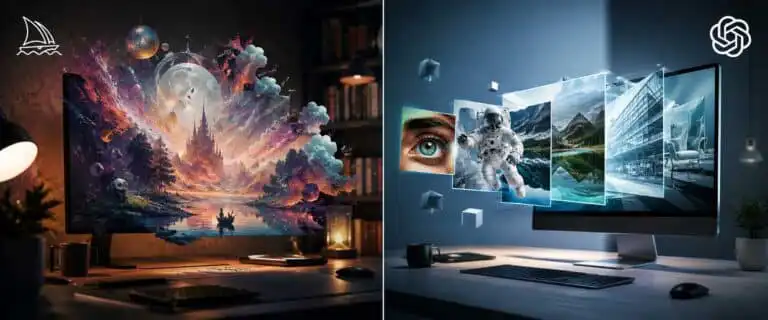
DALL·E, now best understood as OpenAI GPT Image inside ChatGPT, wins on prompt-following, readable text and practical editing. Midjourney wins on artistic, cinematic style and the kind of visual polish that makes a first draft feel like a finished moodboard. The honest answer is that it depends on your prompt, so the smartest move is to run the same prompt through both and compare the results before committing to one workflow.
This Midjourney vs DALL·E comparison is for creators, marketers, publishers and small teams choosing between two image models for real work, not just demo images. The scoring below uses DIY AI’s 2026 image-generation dataset, where OpenAI GPT Image 2 scores 9.6/10 overall and Midjourney V7 scores 9.1/10 overall. For wider category rankings, use our best AI image generators comparison. This page stays deliberately narrower: two tools, one prompt, one decision.
DIY AI verdict: DALL·E for control, Midjourney for visual taste
Choose DALL·E if the image needs to follow a detailed brief, include readable text, preserve specific objects, or support a back-and-forth editing workflow. It is the safer first choice for blog graphics, product concepts, social ads, instructional images and layouts where the wording or object placement matters.
Choose Midjourney if you care more about atmosphere, lighting, colour grading, characterful compositions and striking creative direction. It is often better for concept art, editorial hero images, cinematic portraits, fantasy visuals and moodboards where the final image can interpret the brief rather than obey every detail.
Midjourney vs DALL·E comparison table
| Category | Midjourney | DALL·E / OpenAI GPT Image |
|---|---|---|
| DIY AI dataset score | 9.1/10 overall for Midjourney V7 | 9.6/10 overall for OpenAI GPT Image 2 |
| Best use case | Art direction, cinematic visuals, concept work and moodboards | Prompt-accurate images, readable text, editing and everyday publishing |
| Image quality | 9.5/10 | 9.8/10 |
| Prompt fidelity | 8.9/10 | 9.8/10 |
| Style range | 10.0/10 | 9.4/10 |
| Consistency | 9.4/10 | 9.6/10 |
| Editing capability | 8.4/10 | 9.6/10 |
| Ease of use | 8.2/10 | 9.8/10 |
| Pricing shape | Subscription-led plans with GPU time limits and higher tiers for heavier use | Available through ChatGPT plans and API token pricing for developers |
| Main trade-off | Better visual personality, weaker exact instruction control | Better practical control, slightly less distinctive visual taste by default |
Quality and style: where Midjourney still feels stronger
Midjourney’s biggest advantage is taste. That sounds subjective, but it shows up in repeatable ways: stronger lighting choices, richer texture, more deliberate compositions and a better sense of cinematic mood. If you prompt for a neon street portrait, a fantasy castle, a luxury perfume campaign, or a dramatic landscape, Midjourney often produces an image that already looks art-directed.
The trade-off is control. Midjourney can follow prompts well, especially when the prompt is visual and style-led, but it is more likely to reinterpret them. That can help during exploration. It is less useful when you need the red mug to stay red, the product to sit on the left, the label to be legible and the background to remain plain white.
Prompt-following and text: why DALL·E is usually safer for publishing
DALL·E has become the name many people still use for OpenAI image generation, but the stronger current comparison is really Midjourney versus OpenAI GPT Image. In DIY AI’s dataset, OpenAI GPT Image 2 leads on prompt fidelity, realism, editing and ease of use. That matters for practical publishing because most content teams do not just ask for “a beautiful image”. They ask for a specific hero graphic, a product concept, a meme layout, a diagram, an advert mockup or an image with visible words.
Text handling is the clearest separator. Midjourney can create beautiful poster-like visuals, but text inside the image is still a risk area. DALL·E is more reliable when the prompt includes labels, signs, packaging copy, UI text or short headline-style wording. OpenAI’s own ChatGPT Images 2.0 release notes highlight improved text rendering, multilingual support, and more flexible aspect ratios, which help explain why the tool scores so strongly for practical output.
Control over tone, layout and structure
In terms of visual tone, Midjourney is the more opinionated model. It has a strong house feel, especially around cinematic lighting, character shots, painterly detail and surreal editorial compositions. That is a strength when you want a striking look quickly. It can be a weakness when the brief has a fixed brand style, and you need the model to stay quiet.
DALL·E is better when structure matters. It handles conversational revision more naturally: make the background warmer, keep the same character, remove the extra object, make the sign read this exact phrase, and change the crop to portrait. That back-and-forth makes it easier to produce assets for a real page rather than one impressive gallery image. For prompt structure, our AI photo prompt guide is a useful companion because small wording changes can flip the winner.
Handling complex and longer prompts
Complex prompts expose the real gap. Midjourney can produce excellent images from dense creative briefs, but it may prioritise mood over the order of instructions. DALL·E is usually better when a prompt contains several constraints: subject, placement, text, format, brand-safe tone, lighting, background, aspect ratio and a correction request.
That does not make DALL·E more creative. It makes it more obedient. For commercial work, obedience often matters more than surprise. For exploratory art direction, surprise may be exactly what you want.
Pricing: Which one is cheaper?
Midjourney pricing is easier to understand at a glance because it is subscription-led. The official plan structure runs from Basic to Mega, with higher tiers adding more GPU time, Relax Mode access and privacy options. If you generate often and like Midjourney’s style, the subscription can feel predictable.
DALL·E pricing depends on how you access it. Many users will use it through ChatGPT, where image access is tied to the plan and current usage limits. Developers and product teams can also use OpenAI image models via API pricing, with costs based on tokens rather than a simple monthly image allowance. That is better for product integration, but less intuitive for a solo creator comparing monthly bills.
Pros and cons: Midjourney
| Pros | Cons |
|---|---|
| Best-in-class style range in DIY AI’s dataset at 10.0/10. | Less reliable than DALL·E for exact prompt-following. |
| Excellent for cinematic, artistic and editorial images. | Weaker for readable text, labels and strict layouts. |
| Strong visual consistency and a distinctive creative feel. | Editing workflow is not as natural for everyday content revisions. |
Pros and cons: DALL·E / OpenAI GPT Image
| Pros | Cons |
|---|---|
| Top score on DIY AI’s dataset: 9.6/10 overall. | Top score in DIY AI’s dataset at 9.6/10 overall. |
| Excellent prompt fidelity, editing and readable text handling. | Pricing can be less obvious when comparing ChatGPT access with API usage. |
| Very easy to revise images through natural language. | For pure moodboard work, Midjourney may produce the more memorable first draft. |
See more of our reporting in Google Top Stories, AI Overviews and AI Mode.
How to test both on the same prompt
The cleanest test is not to compare random samples from other people. Write one prompt, run it in both tools, then score the output against the job you actually need. Start with subject accuracy, text accuracy, composition, realism, style fit and editability. Then repeat with one harder prompt. A tool that wins once on a simple prompt may fail when the brief includes labels, a specific layout or a reference image.
You can do that directly in the DIY AI Studio, which is the best internal testing tool to go to from this comparison page. The point is not to prove that one model is universally superior. The point is to find which model understands your prompt faster.
Verdict: Which should you use?
Use DALL·E first for most publishing, marketing and editing workflows. It wins the practical categories: prompt-following, image editing, text handling, realism and ease of use. That is why OpenAI GPT Image 2 sits above Midjourney in DIY AI’s 2026 image-generation dataset.
Use Midjourney first when the image needs more atmosphere than obedience. It remains one of the strongest creative generators for cinematic concepts, campaign moodboards, fantasy scenes, stylised portraits and art-led experimentation.
The best workflow is simple: use DALL·E when the brief is strict, use Midjourney when the brief is expressive, and test both when the image matters enough to publish.
FAQs
Is DALL·E better than Midjourney?
DALL·E is better for prompt accuracy, text-in-image, editing, and everyday publishing. Midjourney is better for cinematic style, artistic mood and visually rich first drafts.
Is Midjourney better for realistic images?
Midjourney is excellent for stylised realism and cinematic photography-style images. DALL·E, represented in the DIY AI dataset as OpenAI GPT Image 2, scores slightly higher for realism at 9.8/10 versus Midjourney V7 at 9.6/10.
Which is better for logos, posters and text?
DALL·E is the safer choice when readable text matters. For serious logo work, you should still expect to refine the result in a design tool because image generators can produce attractive concepts without delivering production-ready vector assets.
Should I use both?
Yes, if the image will be used on a live page, ad, thumbnail or client-facing asset. Run the same prompt through both, compare the results, then continue editing in the model that yields the closest result with the fewest corrections.
You Might Also Like:

Best AI Image Tools 2026
AI Image Combiner

AI Photo Prompt