
HeyGen Review 2026: Avatar V, Pricing, Features and Real Limitations
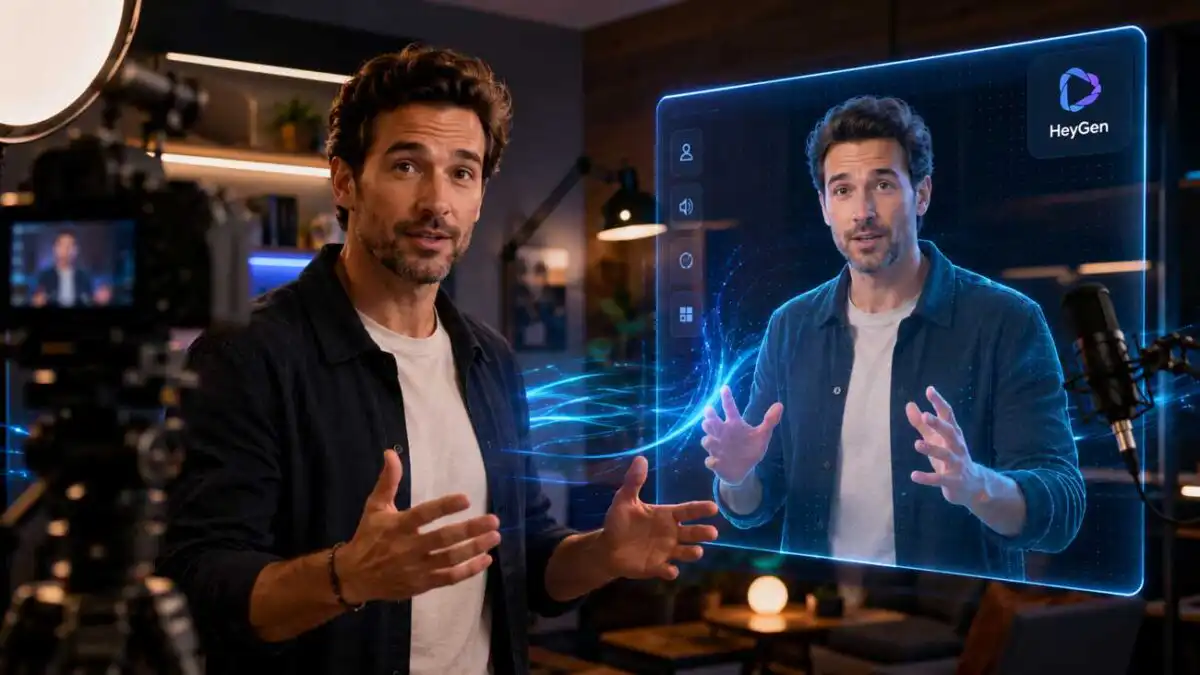
HeyGen is one of the strongest AI video platforms for creating presenter-led marketing videos, training content, product explainers and translated versions of existing footage. Its best feature is no longer simply the ability to make a photograph talk. The platform now combines realistic Digital Twins, three avatar engines, voice cloning, lip-synced translation, an agent that assembles complete videos and a conventional scene editor for correcting the result.
The buying decision is less straightforward than the polished demos suggest. Avatar III is inexpensive enough for routine production, while Avatar IV, Avatar V, expressive motion and agent-generated footage consume credits much faster. A creator who chooses the wrong engine can use a monthly allowance in a fraction of the time implied by the plan’s maximum video duration.
Our verdict is positive, but specific: HeyGen is worth testing for talking-head video, localisation and repeatable brand content. It is not a replacement for cinematic generators such as Runway, Kling or Veo, and its real cost should be measured per accepted minute after revisions rather than per generated minute.
| HeyGen review summary | DIY AI assessment |
|---|---|
| Overall score | 8.2/10 |
| Best for | Avatar videos, localisation and fast marketing explainers |
| Strongest qualities | Voice and lip sync, render speed, ease of use and commercial licensing |
| Main weakness | Premium avatar engines and failed iterations can raise the effective production cost |
| Best-value engine | Avatar III for routine presenter videos |
| Best-quality engine | Avatar V for realistic, video-trained human Digital Twins |
| Recommended first plan | Creator for evaluation, Pro for regular premium-engine production |
Bottom line: HeyGen is worth trying if a presenter, spokesperson or translated speaker is central to the video. It is a weaker purchase for users who mainly want cinematic scenes, elaborate camera moves, or characters physically interacting with objects.
How DIY AI evaluated HeyGen
DIY AI evaluates video generators across output quality, prompt accuracy, voice and lip sync, editing flexibility, render speed, character consistency, templates, commercial licensing and ease of use. The scoring framework and category methodology are published on our AI tool data methodology page, while the current results sit in the AI video generation tools dataset.
HeyGen scores 8.2/10 overall. Its 9.2 scores for render speed and ease of use make it one of the quickest platforms to learn, while voice and lip sync score 8.9. Prompt accuracy is lower at 7.2 because a convincing avatar delivery does not mean every gesture, scene choice or agent-generated visual will follow the instruction precisely.
HeyGen
HeyGen scored across 10 practical dataset metrics in our hands-on testing.
- Visual Realism8.6/10★★★★★★★★★★
- Personality/Script Fidelity8.4/10★★★★★★★★★★
- Emotional Range8.2/10★★★★★★★★★★
- Interactivity8.4/10★★★★★★★★★★
- Lip Sync8.6/10★★★★★★★★★★
- Background/Scene Control8/10★★★★★★★★★★
- Customization8.4/10★★★★★★★★★★
- Commercial Use8.8/10★★★★★★★★★★
- Ease of Use9/10★★★★★★★★★★
What is HeyGen?
HeyGen is an AI video platform built around digital presenters and identity-preserving avatars. A user can select a stock avatar, train a Digital Twin from personal footage, animate a photograph, clone a voice, paste a script and generate a presenter-led video without filming every delivery.
That description now covers only part of the product. AI Studio provides scene-based manual editing. Video Agent can plan and generate a complete video from a prompt, script, URL or uploaded source. Translation tools dub existing footage and rebuild the speaker’s lip movements. LiveAvatar supplies real-time, conversational avatars for websites and applications. Business plans add collaboration, interactive video, SCORM export and learning-management integrations.
The key distinction is between identity-led video and open-ended scene generation. HeyGen is designed to preserve a recognisable presenter, voice and message across repeated videos. A cinematic generator is designed to create new environments, camera movement and physical action. HeyGen can insert generated B-roll and visual assets, but its avatar remains the centre of gravity.
HeyGen Avatar V review: The most realistic option for a personal Digital Twin
Avatar V is HeyGen’s premium engine for realistic human Digital Twins. It learns movement from a short reference recording and combines that motion profile with a base look and voice. The objective is not just accurate lip movement. The objective is to retain the person’s expressions, gaze, gesture style, and general on-camera energy across new scripts and settings.
The 15-second recording has more influence than most users expect
Avatar V learns its movement from a 15-second video. That sounds convenient, but it also means the source clip carries a great deal of responsibility. A reserved recording tends to produce restrained output. A more expressive recording provides clearer examples of hand movement, facial response and eye contact for the model to reuse.
The sensible workflow is to record several short motion references rather than treating the first acceptable clip as permanent. Create one calm reference for educational material, one more energetic reference for social content and another with restrained hand movement for tightly framed product videos. This gives the platform a better starting point than trying to force every performance through text instructions later.
Voice quality is part of the animation system
Avatar V uses the audio delivery as a major motion signal. Flat narration can make the visual performance feel stiff even when the avatar image is strong. A dedicated voice clone recorded with natural changes in pace, emphasis and emotion generally gives the engine more useful information than relying on the audio captured during avatar training.
This creates a practical dependency that is easy to miss. Improving the avatar image alone will not solve dull delivery. The recording, voice clone and base look need to work as one system.
Base-look quality controls identity consistency
The base look is the reference image used to define the presenter’s identity, clothing and initial framing. Clear facial detail, a natural expression and an angle that matches the intended motion reference provide the safest foundation. Large smiles, obscuring accessories and unusual side angles create more opportunities for the generated mouth, teeth or face shape to drift.
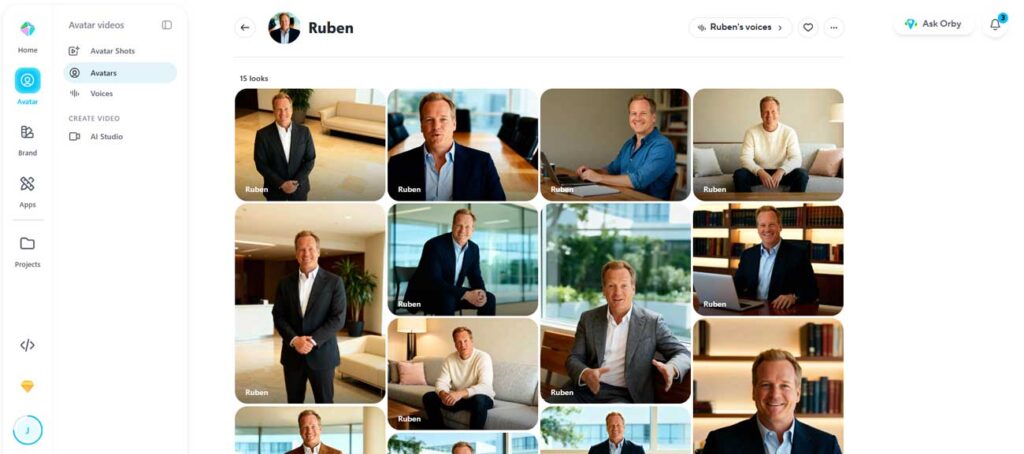
Avatar V is particularly useful when one person needs several visual versions of the same identity. Different clothes, settings and formats can be created without filming a new delivery each time. The limitation is that generated looks still need inspection. Identity can remain recognisable while smaller details such as jewellery, teeth, fingers, clothing edges or background objects change.
Where Avatar V still looks artificial
The strongest outputs are usually waist-up or close-up presenter shots with a clear script and a controlled background. The illusion becomes less reliable when the scene demands full-body movement, prop interaction or a sequence of precisely timed gestures. Eye contact can also feel too fixed, while repeated head movement may become predictable across longer clips.
Avatar V should therefore be treated as a high-quality virtual presenter, not as an actor who can be directed through a complex physical scene. Cutting between the avatar, screen recordings, diagrams and B-roll usually produces a more convincing result than leaving the Digital Twin on screen continuously for several minutes.
Avatar III vs Avatar IV vs Avatar V
HeyGen’s three avatar engines are not simple quality tiers where the newest model should always be selected. Each engine is better suited to a different production job, and the cost gap is large enough to change the economics of an entire content workflow.
| Avatar engine | Best use | Practical strength | Credit rate | Main trade-off |
|---|---|---|---|---|
| Avatar III | Routine presenter videos, explainers and high-volume updates | Low-cost, consistent generation | 3 credits per minute | Less advanced motion and expression |
| Avatar IV | Photo avatars, stylised characters, 2D or 3D subjects and non-human presenters | Creative prompting and expressive photo animation | 20 credits per minute | Costs over six times more than Avatar III |
| Avatar V | Real people, video-trained Digital Twins and identity-sensitive content | Stronger human consistency, mannerisms and natural performance | 20 credits per minute | Input quality heavily affects the result |
Choose Avatar III when the message matters more than the performance
Avatar III is the sensible default for recurring internal updates, simple tutorials, product announcements and scripts where the presenter mainly needs to speak clearly. It is also the best engine for testing scripts, layouts and pacing before committing premium credits to the final render.
A strong cost-control workflow is to draft the whole project with Avatar III, approve the script and scene timing, then switch only the most visible scenes to Avatar V. There is little value in paying the premium rate for an avatar that appears briefly between long stretches of screen recording or B-roll.
Choose Avatar IV for creative photo-based characters
Avatar IV remains relevant because it handles photo avatars and stylised characters that do not have a real person’s motion profile. It is the better fit for mascots, illustrations, historical photographs, fictional presenters and non-human subjects. Free-text motion prompting also gives it useful creative flexibility.
Choose Avatar V for a recognisable person
Avatar V is the better investment when viewers already know the presenter, when brand identity must remain stable or when a founder wants to produce repeated videos without recording each script. Its value comes from preserving the person, not from creating elaborate scenes.
Creating a HeyGen Digital Twin without wasting the first training attempt
A Digital Twin is more demanding than uploading a convenient clip from a phone. The recording needs to give the model clean information about the face, voice, posture and movement. Cuts, camera changes, poor audio, heavy compression and inconsistent lighting weaken that information.
Use a continuous take, keep the camera stable and frame the subject closely enough to preserve facial detail. Look towards the lens rather than a nearby script window. Natural movement is useful, but the speaker should not leave the frame or repeatedly cover the face. A plain or uncluttered background also makes the edges of the body easier to model.
Record motion and voice for different purposes
The avatar recording teaches visual identity and movement. The voice-clone recording teaches tone, pronunciation and vocal character. Combining both tasks into one rushed clip is convenient but rarely optimal. A separate voice sample can include controlled changes in pace, questions, emphasis and specialist terminology without forcing the avatar-training footage to carry the same burden.
Build a small library of approved looks
Generating dozens of outfits before approving one strong base look wastes credits and makes quality control harder. Start with a neutral, reusable appearance. Check the face from several script lengths and emotional deliveries. Only then create additional looks for different campaigns, backgrounds or aspect ratios.
The operational goal is consistency, not maximum novelty. A small set of dependable looks is more valuable than a large gallery that needs to be checked from scratch in every project.
Gesture control is useful, but it is not full scene direction
Avatar IV and Avatar V support instructions for facial expression, hand gestures, body posture, gaze and stillness. Avatar V also provides structured controls for expression, gesture and gaze. These controls can improve a scene when the required action is visually simple: looking towards the camera, nodding, waving, leaning forward or keeping the hands still.
The reliable prompting pattern is one visible gesture paired with one expression. For example, asking the avatar to nod confidently while maintaining eye contact is more controllable than requesting a sequence of waving, pointing, turning, walking and picking up an object.
Motion prompts do not control camera zooms, pans, scene changes, lighting, backgrounds, prop use or walking around the space. Those elements need to be created elsewhere in the editor or supplied as separate footage. This is one of HeyGen’s clearest boundaries and should shape the script before generation begins.
HeyGen AI Studio review: Better for finishing than starting from a blank timeline
AI Studio is HeyGen’s scene-based editor. It combines scripts, avatars, voice controls, uploaded media, stock footage, captions, text, music, transitions and brand assets. Users can import a presentation or PDF, record a screen, save templates and switch between landscape and vertical formats.
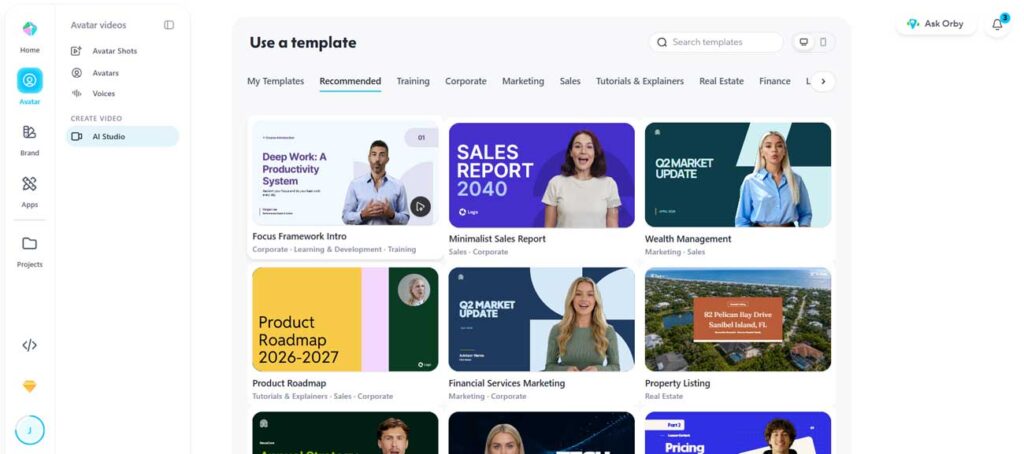
The editor is easier to learn than a traditional video package because it treats each section as a scene rather than an unrestricted timeline. That simplicity is also a limitation. Precise audio mixing, advanced compositing, masking and detailed keyframe work still belong in a dedicated editor.
Voice Director and Voice Mirroring improve delivery in different ways
Voice Director uses written direction to influence tone, pace and emotion. It is useful when the script is final, and the required performance can be described clearly. Voice Mirroring is speech-to-speech: the user records the delivery, and the selected voice follows its rhythm and emotional shape.
Voice Mirroring is often the more controllable route for a specific line because the performance is demonstrated rather than described. It also reduces the tendency to keep rewriting punctuation in the hope that a text-to-speech engine will infer the intended emphasis.
Previewing the right elements saves credits
Layout, captions, media placement and timing can be adjusted without regenerating the avatar. Changes to the script, voice or avatar performance can require another render. Approve the non-generative parts first, then lock the script before spending credits on the final avatar scenes.
This is a small workflow choice with a large cost effect. The expensive mistake is using a premium engine while the team is still debating wording, slide order or caption style.
HeyGen Video Agent review: A useful first cut, not an autonomous editor
Video Agent can take a prompt, script, URL or uploaded material and create a planned video containing an avatar, voiceover, captions, B-roll, generated visuals, motion graphics and transitions. It offers a chat-led planning mode and a more automated mode that moves from the brief into production with less intervention.
The planning stage is the valuable part. A user can review the proposed structure, refine the script, define the visual style and request changes before generation. This reduces the risk of paying for a polished version of a weak plan.
Use Video Agent for assembly, then AI Studio for control
The best workflow is not to ask Video Agent for a finished masterpiece and publish whatever appears. Use it to create the first coherent cut, then transfer a copy into AI Studio. There, individual media assets, captions, timing, transitions, layouts, voices and avatar scenes can be corrected directly.
A recurring pattern in real-world user reports is that agent-generated video feels efficient until one scene is wrong. Vague correction prompts can alter elements that were already acceptable. Editing one scene at a time and stating both what should change and what must remain fixed produces a more predictable result.
Generated B-roll is not automatically relevant B-roll
Video Agent can create or select visual material that matches the broad topic while missing the specific claim being made. A business video may look polished but still show generic offices, abstract graphics or product footage that adds no evidence. Review each visual against the sentence it supports, especially in technical, financial or regulated content.
The agent is strongest at format and pacing. Editorial accuracy remains the user’s job.
Check the in-product cost before generation
HeyGen’s public pricing page and its current help documentation do not show the same standard Video Agent credit rate. The product displays the expected cost before generation, so that estimate should be treated as the final figure for the selected model and settings. This is particularly important when cinematic asset models are enabled, because they can consume substantially more credits than a basic agent project.
Voice cloning and third-party voices
HeyGen includes voice cloning on paid plans and supports more than 175 languages and dialects. AI Studio can also use different voice engines, including HeyGen’s expressive options and connected third-party voices. This gives teams a choice between convenience, emotional control, multilingual coverage and an established external voice library.
Voice quality should be tested with difficult material rather than a friendly marketing paragraph. Names, abbreviations, product codes, prices, dates and specialist terminology expose weaknesses quickly. A brand glossary and pronunciation review are more valuable in production than another minor improvement in general voice naturalness.
Voice Mirroring is the practical answer to awkward emphasis
Text instructions such as “sound confident” are open to interpretation. A reference recording gives the system actual timing, stress and emotional shape. For founder videos, sales messages and scripts with deliberate pauses, mirroring can save several rounds of regeneration.
The trade-off is time. Recording every line reduces the automation benefit. Use it for openings, calls to action, sensitive claims and lines where delivery carries meaning. Standard text-to-speech is usually sufficient for connective narration.
HeyGen video translation and lip sync
HeyGen can translate existing videos, clone or replace the speaker’s voice and rebuild mouth movement to match the target language. This is one of the platform’s clearest commercial strengths because the original presenter, framing and visual edit can be reused across markets.
There are three distinct cost and quality levels: audio dubbing without lip sync, standard lip-synchronised translation and Precision translation. Audio-only dubbing is cheapest. Standard lip sync is a sensible default for short marketing material. Precision mode costs more and should be reserved for close-up footage, important launches or languages where the standard result produces visible timing errors.
Translation quality needs a human review before lip sync
Generating the final mouth movement before approving the translated script can waste the most expensive step. Review brand names, technical terms, numbers, claims and cultural phrasing first. Pro and higher plans add translation-script editing, which is a meaningful upgrade for teams producing customer-facing material.
Multiple speakers, fast dialogue, overlapping speech and frequent cuts increase the review burden. The tool can reduce localisation work dramatically, but it does not remove the need for a fluent reviewer who understands the subject.
Other HeyGen features worth testing
Generated looks and personal model training
HeyGen can create new appearances for a Digital Twin and train a personal model to improve look generation. This is useful for recurring campaigns where the same identity needs different clothing, environments or visual themes. The sensible order is identity approval first, personal model training second and look expansion last.
Product Placement
Product Placement combines an avatar with a product image to produce presenter-led advertising footage. It can accelerate early ad concepts and product demonstrations, but the product must be checked carefully for altered labels, proportions, reflections and grip. It is better suited to concept testing and lightweight social creative than evidence-heavy demonstrations of how a physical product operates.
Speech Cleanup
Speech Cleanup removes pauses, filler words and mistakes while attempting to hide the visual cuts created by those removals. This is more useful than audio-only cleanup for talking-head footage because a clean soundtrack paired with visible jump cuts still looks edited. The feature is most effective on small corrections; aggressive removal can make timing and body movement feel unnaturally compressed.
Batch Mode and personalised video
Batch Mode can produce multiple single-scene avatar videos from structured scripts, while personalised-video workflows can populate templates with recipient or account data. These features are valuable for sales outreach, onboarding and localised campaigns, but they introduce an approval problem: one template mistake can be repeated across every generated asset. Test a small batch and inspect the variable fields before scaling.
HyperFrames, integrations and agent-led workflows
HeyGen is expanding beyond its own editor through pre-built agent workflows, cloud rendering, MCP connections and integrations with automation platforms. A script or trigger can move from another system into video generation without manual copying. This is useful for repeatable content such as product updates, support explainers and internal reports.
Automation magnifies both good and bad inputs. Brand rules, approved templates, pronunciation data, content checks and credit limits should be established before an automated workflow is allowed to publish or create large batches.
LiveAvatar is a separate product for real-time conversations
LiveAvatar streams an avatar that can listen and respond during a live session. It is designed for virtual sales assistants, tutors, support agents, interactive demonstrations and other experiences where the user speaks to the avatar rather than watching a pre-rendered video.
The avatar provides the face, lip sync and body language. A language model, knowledge base and speech system still need to control what it says. This makes LiveAvatar an application component rather than a no-code substitute for a complete conversational system.
Custom setup also requires more demanding source footage than a short Avatar V motion reference. Developers need to plan session handling, latency, fallback behaviour, moderation, prompt length and the cost of keeping an avatar stream active. For most marketing teams, pre-rendered HeyGen video is the simpler product. LiveAvatar is justified when two-way interaction creates measurable value.
HeyGen pricing in 2026
HeyGen currently offers Free, Creator, Pro, Business and Enterprise plans. The official HeyGen pricing page should be checked before purchase because credit allocations, model rates and regional free allowances can change.
| Plan | Monthly price | Included usage | Best fit |
|---|---|---|---|
| Free | $0 | Up to 3 videos per month, each up to 1 minute, with limited premium access | Testing avatars, workflow and basic output quality |
| Creator | $29 | 600 credits, videos up to 30 minutes, 1080p export, voice cloning and watermark removal | Solo creators and occasional production |
| Pro | From $49 | From 1,000 credits, 4K export and translation-script editing | Regular premium-avatar and localisation work |
| Business | $149 plus $20 per additional seat | 1,500 shared credits, 60-minute videos, collaboration, SSO, interactive video, SCORM and integrations | Teams, training departments and governed workflows |
| Enterprise | Custom | Flexible generation, highest concurrency, advanced controls and support | Large-scale production and regulated organisations |
How far do 600 HeyGen Creator credits actually go?
Plan limits such as “videos up to 30 minutes” describe the maximum length of a project, not the amount of premium output included. The same 600-credit Creator allowance produces very different quantities depending on the engine.
| Feature | Credit rate | Approximate output from 600 credits | Approximate included cost |
|---|---|---|---|
| Avatar III | 3 credits per minute | 200 minutes | $0.15 per generated minute |
| Avatar IV or Avatar V | 20 credits per minute | 30 minutes | $0.97 per generated minute |
| Custom Expressive Motion | 40 credits per minute | 15 minutes | $1.93 per generated minute |
| Translation without lip sync | 2 credits per minute | 300 minutes | $0.10 per source minute |
| Translation with lip sync | 5 credits per minute | 120 minutes | $0.24 per source minute |
| Precision translation | 10 credits per minute | 60 minutes | $0.48 per source minute |
These figures are theoretical. They assume every generated second is accepted and that no credits are used for image assets, generated looks, model training, cinematic footage or other features. A rejected one-minute Avatar V render does not merely cost another minute of work. It can double the effective price of the accepted version.
Creator and base Pro have similar unit economics
Creator provides 600 credits for $29, while the entry Pro tier provides 1,000 for $49. Both work out at roughly five cents per included credit. Pro is worth buying for additional capacity, 4K export and translation editing, not because its base credit price is dramatically lower.
Business pricing buys team controls, not cheap generation
The Business plan’s 1,500 credits are shared across the workspace. Its headline cost per included credit is higher than Creator or entry Pro because the plan also pays for seats, collaboration, SSO, interactive video, SCORM export, central billing and integrations. A solo user should not choose Business merely to obtain more avatar minutes.
Measure cost per accepted minute
The most useful budgeting metric is:
Total monthly plan and top-up cost divided by the duration of approved, publishable output.
This captures script changes, rejected gestures, translation corrections, failed renders and alternate versions. It also clarifies Avatar III’s role. Using the inexpensive engine for drafts can reduce premium re-renders without lowering the quality of the final approved scenes.
HeyGen API pricing and automation costs
HeyGen’s API is billed separately from the normal web subscription. Standard Avatar III generation is the lowest-cost route, while Avatar IV, high-resolution output, translation and Video Agent increase the per-minute charge. Custom Digital Twin creation through the API can also require enterprise access.
The API makes sense when a system needs to create personalised or recurring videos automatically. It is less attractive when every output still needs extensive manual editing. Before building an integration, test the full approval loop: input validation, generation, status checks, failed-job handling, human review, storage and delivery. The generation endpoint is only one part of the production cost.
HeyGen’s real limitations
Premium credits disappear quickly during experimentation
Avatar V looks impressive enough to invite experimentation with gestures, looks and voices. Each retry, however, is part of the production budget. Teams should approve the script, voice and framing with lower-cost previews before exploring minor performance variations.
Long continuous avatar footage exposes repetition
A Digital Twin can remain coherent for extended scripts, but repeated gestures, fixed eye contact and uniform framing become easier to notice over time. Breaking a long video into visual chapters with diagrams, screen recordings and relevant B-roll improves both realism and viewer attention.
Prompts cannot direct physical acting
HeyGen can influence a presenter’s expression and simple body language. It cannot reliably choreograph a person walking through a room, using a device, drinking from a cup or interacting naturally with several objects. Those scenes still need recorded footage or a different generation system.
Video Agent needs editorial supervision
An automatically assembled video may be coherent without being accurate, distinctive or on-brand. Generic visuals, repeated stock concepts and weak scene choices can make a correct script feel disposable. The agent removes assembly work, not editorial responsibility.
Documentation and in-product rates can move at different speeds
HeyGen has changed from older unlimited and premium-credit structures to a shared credit model. Some help pages and pricing summaries can lag behind product changes or show conflicting feature rates. Check the cost displayed inside the generation flow before approving a large project.
Realistic does not mean undetectable
Strong lip sync and identity consistency can still be undermined by overly smooth skin, fixed gaze, repetitive hand movement, odd teeth or a voice that lacks natural breath and emphasis. The best result is often a well-edited hybrid video, not an uninterrupted avatar monologue.
Common HeyGen mistakes and how to avoid them
| Mistake | Better workflow |
|---|---|
| Using Avatar V for every draft | Approve scripts and timing with Avatar III, then upgrade selected scenes |
| Training from flat, low-energy footage | Record expressive motion references with clear eye contact and stable framing |
| Trying to solve voice problems with visual prompts | Create a dedicated voice clone or use Voice Mirroring for important lines |
| Requesting several gestures in one prompt | Use one clear movement with one supporting expression |
| Generate lip sync before checking translation | Proofread names, claims, numbers and terminology before the final render |
| Publishing a Video Agent result unchanged | Move the project into AI Studio and review each scene against the script |
| Buying Business for cheaper credits | Choose it for collaboration, security, learning features and governance |
| Automating before establishing quality checks | Define approved templates, fallbacks, credit limits and human review first |
HeyGen pros and cons
| Pros | Cons |
|---|---|
| Excellent voice and lip-sync performance. Avatar V creates convincing human Digital Twins. Avatar III supports affordable high-volume production. Strong multilingual translation workflow. Fast, accessible scene-based editor. Useful voice mirroring and performance controls. Video Agent creates editable first drafts. Business features cover training and collaboration. API and automation options support scaled workflows | Avatar IV and V consume credits quickly. Failed or rejected generations raise real costs. Complex physical action remains outside its strengths. Long avatar shots can expose repeated movement. Video Agent still needs editorial correction. Advanced editing is limited beyond dedicated software. LiveAvatar requires technical implementation. Pricing documentation can show conflicting rates. Not a general cinematic text-to-video replacement |
Who should use HeyGen?
- Marketing teams: for product explainers, campaign variations, social videos and presenter-led landing-page content.
- Training departments: for reusable presenters, interactive lessons, SCORM export and multilingual updates.
- Founders and subject specialists: for creating a Digital Twin that can deliver approved scripts without repeated filming.
- Localisation teams: for dubbing and lip-syncing existing video into multiple languages.
- Agencies: for repeatable avatar production, client templates and controlled brand systems.
- Developers: for personalised video, automated generation and real-time avatar applications.
Who should avoid HeyGen?
- Filmmakers who mainly need cinematic scenes, complex camera movement or physical acting.
- Users who want a flat monthly fee with no need to monitor generation credits.
- Teams that cannot review translations, synthetic voices or generated visuals before publication.
- Creators whose videos depend on natural demonstrations with products, tools or changing locations.
- Low-volume users who already film comfortably and only need conventional editing.
HeyGen vs Synthesia, Arcads and cinematic AI video tools
| Comparison | Choose HeyGen when | Choose the alternative when |
|---|---|---|
| HeyGen vs Synthesia | You prioritise realistic personal Digital Twins, social content and flexible avatar presentation | You prioritise a more traditional enterprise training environment and corporate presenter workflow |
| HeyGen vs Arcads | You need broad avatar, translation, training and automation capabilities | You mainly need rapid AI UGC advertising concepts and direct-response creative variations |
| HeyGen vs Runway, Kling or Veo | A consistent speaker or translated presenter is central to the message | The scene, camera, environment and physical action are central to the message |
| HeyGen vs ElevenLabs | You want voice, avatar, lip sync and editing in one platform | Voice quality, control and audio production are more important than the visual presenter |
HeyGen and a specialist voice platform can also work together. The strongest workflow may use an external voice for narration and HeyGen for visual identity and lip sync. This adds another subscription and another approval step, but it can improve important founder, training or advertising content.
HeyGen review verdict: Is it worth the price?
HeyGen is worth testing because it solves a defined production problem well: turning a consistent person, character or translated speaker into repeatable video without filming each delivery. Avatar V strengthens the product for recognisable human Digital Twins, while Avatar IV remains useful for photo-based and stylised characters. Avatar III keeps routine production financially practical.
The platform becomes expensive when every experiment uses a premium engine. Creator is the best starting point for evaluating a Digital Twin, voice, translation and editor. Pro is the more sensible plan for regular Avatar V production because it adds capacity, 4K output and translation editing. Business is justified by collaboration, SSO, interactive learning, SCORM and governance, not by cheaper included generation.
The best HeyGen workflow is hybrid. Use Avatar III for drafts, Avatar V for identity-critical scenes, Video Agent for assembly, AI Studio for correction and external footage wherever physical action or visual proof is required. That approach plays to HeyGen’s strengths without asking the avatar engine to behave like a complete film studio.
HeyGen frequently asked questions
Is HeyGen free?
Yes. The Free plan allows a limited number of short videos each month and provides trial access to core avatar and agent features. It is suitable for checking the workflow and output quality, but not for regular production.
How much does HeyGen cost?
Creator costs $29 per month with 600 credits. Pro starts at $49 per month with 1,000 credits. Business costs $149 per month for the first seat, includes 1,500 shared credits and charges $20 per additional seat. Enterprise pricing is customised.
What is the difference between Avatar III, Avatar IV and Avatar V?
Avatar III is the low-cost engine for basic presenter videos. Avatar IV is strong for photos, stylised characters and creative prompting. Avatar V is designed for realistic human Digital Twins trained from video-based motion.
How many Avatar V minutes are included with HeyGen Creator?
Avatar V uses 20 credits per minute. A 600-credit Creator allowance therefore provides up to 30 generated minutes if no credits are spent elsewhere and every render is accepted.
Does HeyGen clone your voice?
Yes. Paid plans include voice cloning, and AI Studio also supports voice mirroring, directed delivery and selected third-party voice integrations.
Can HeyGen translate an existing video?
Yes. It can provide audio-only dubbing, standard lip-synchronised translation or a higher-cost Precision mode. Translation scripts should be reviewed before generating the final lip sync.
Can HeyGen videos be used commercially?
HeyGen supports commercial use, subject to its current terms, the user’s rights to all uploaded media and any restrictions attached to third-party assets or voices. Teams should keep consent and licensing records for custom avatars and cloned voices.
Can HeyGen create full cinematic videos?
Video Agent can assemble avatars, B-roll, generated visual assets, captions and motion graphics. HeyGen is still strongest for presenter-led video. Runway, Kling and Veo are better suited to open-ended cinematic scenes and complex physical action.
Does HeyGen have an API?
Yes. The API supports avatar generation, translation, Video Agent and other automated workflows. API billing is separate from the normal web subscription, and some custom-avatar capabilities require enterprise access.
Is HeyGen better than Synthesia?
HeyGen is often the better choice for personal Digital Twins, social and marketing video, expressive voice control and flexible avatar-led production. Synthesia may suit organisations that prioritise structured enterprise training and a conventional corporate presenter workflow.
You Might Also Like:

Best AI Video Generators

Best Image To Video AI

AI Ad Video Generator