10 Best AI Speech-to-Text Tools 2026: Accuracy, Speed & Pros/Cons
The best AI speech-to-text tools in 2026 are no longer judged by word error rate alone. Accuracy still matters, but it now sits alongside latency, diarisation, punctuation, noise handling, export control, real-time streaming, and how well the transcript can be used within a wider AI workflow.
This guide compares all 10 providers in our updated 2026 AI speech-to-text dataset: OpenAI Whisper, Deepgram, AssemblyAI, Speechmatics, Azure AI Speech, Google Gemini Flash STT, Suno/Bark (STT), Otter.ai, AWS Transcribe and Rev AI. It is built for readers choosing between transcription APIs, meeting note tools, live captioning systems, call analytics platforms and developer-ready speech infrastructure.
The short version is simple: OpenAI Whisper is still the strongest overall pick for high-accuracy transcription; Deepgram is the best real-time streaming engine; AssemblyAI is strongest for speech intelligence; Speechmatics is the safest shortlist option for accents and multilingual work; and Azure AI Speech remains the enterprise choice for Microsoft-heavy teams.
Best AI speech-to-text tools 2026: quick rankings
These rankings use our internal 2026 speech-to-text scoring file. The overall score is out of 10. The star rating is a reader-friendly conversion of that overall score into a 5-star scale.
| Rank | Provider | Best for | Accuracy | Speed | Diarisation | Real-time streaming | Overall | Star rating |
|---|---|---|---|---|---|---|---|---|
| 1 | OpenAI Whisper | Open-source high accuracy | 9.6 | 8.8 | 9.2 | 8.8 | 9.2 | 4.6/5 |
| 2 | Deepgram | Real-time and AI agents | 9.3 | 9.9 | 8.9 | 9.9 | 9.1 | 4.6/5 |
| 3 | AssemblyAI | Speech intelligence | 9.2 | 8.9 | 9.1 | 8.9 | 9.0 | 4.5/5 |
| 4 | Speechmatics | Global accents | 9.4 | 8.5 | 9.3 | 8.5 | 8.8 | 4.4/5 |
| 5 | Azure AI Speech | Microsoft enterprise teams | 8.9 | 8.7 | 8.8 | 8.7 | 8.7 | 4.4/5 |
| 6 | Google Gemini Flash STT | Multimodal integration | 8.8 | 9.0 | 8.5 | 9.0 | 8.6 | 4.3/5 |
| 7 | Suno/Bark (STT) | Creative audio | 8.5 | 8.2 | 8.0 | 8.2 | 8.2 | 4.1/5 |
| 8 | Otter.ai | Meetings and collaboration | 8.4 | 8.5 | 8.7 | 8.5 | 8.1 | 4.1/5 |
| 9 | AWS Transcribe | Enterprise AWS pipelines | 8.4 | 8.4 | 8.3 | 8.4 | 8.0 | 4.0/5 |
| 10 | Rev AI | Human-verified hybrid workflows | 8.2 | 8.3 | 8.2 | 8.3 | 7.9 | 4.0/5 |
AI Speech-to-Text Tools 2026 Dataset
The scores above come from our AI Speech-to-Text Tools 2026 Dataset. We score each provider against practical production criteria rather than a single clean-audio benchmark. That matters because real transcription breaks in messy places: overlapping speakers, weak microphones, regional accents, call-centre compression, background noise, filler words, technical vocabulary and multi-language switching.
Download the AI Speech-to-Text Tools 2026 CSV
How we compare AI speech-to-text tools
Old speech-to-text comparisons often over-weighted the word error rate. WER is useful, but it can hide problems that matter more in production. A model can score well on clean English audio and still be frustrating in meetings, live agents, noisy interviews or multilingual customer calls.
For this 2026 comparison, we use the following criteria:
- Accuracy: how reliably the tool captures the spoken words, including names, numbers and technical phrases.
- Speed: how quickly the transcript is returned for batch or near-real-time work.
- Speaker detection: how well the system recognises different voices.
- Punctuation: whether the transcript is readable without heavy manual editing.
- Diarisation: how well it labels who said what, especially in meetings or interviews.
- Noise robustness: how well it copes with imperfect microphones, rooms and compressed audio.
- Export formats: how easily the output fits into captions, analytics, documentation or developer workflows.
- Cost efficiency: whether the result justifies the likely spend once implementation work is included.
- Real-time streaming: whether it can support live captions, voice agents and interactive systems.
We also consider each provider’s position in the wider workflow. For example, OpenAI Whisper can be excellent for finished transcripts, but Deepgram may be the better choice for a voice agent that needs fast partial transcripts. Otter.ai is not trying to be the same product as AWS Transcribe. Rev AI has a different role again because it sits closer to hybrid human-reviewed transcription workflows.
Tool-by-tool comparison: the 2026 leaders
OpenAI Whisper – best overall AI speech-to-text tool
OpenAI Whisper ranks first in our 2026 dataset, with an overall score of 9.2/10. It is still the strongest all-round option when transcript quality, handling noisy audio, and open-source flexibility matter more than turnkey meeting features.
The reason Whisper remains difficult to displace is consistency. It scores 9.6/10 for accuracy, 9.4/10 for speaker detection and 9.4/10 for noise robustness. That makes it a strong fit for interviews, research recordings, podcasts, lectures, YouTube captions, internal knowledge capture and local-first developer projects.
The trade-off is product polish. Whisper is a model family and deployment pattern more than a complete business transcription platform. If you want dashboards, call analytics, compliance tooling, built-in summaries and low-latency streaming out of the box, Deepgram, AssemblyAI, Azure or Google may require less engineering work.
For a deeper standalone breakdown, read our OpenAI Whisper Review 2026.
Best for: high-accuracy transcription, local workflows, research, interviews, long-form audio and developer projects where control matters.
Pros: best dataset accuracy score, strong noise handling, good punctuation, flexible deployment options, strong value for accuracy-led work.
Cons: less turnkey than full speech platforms; live streaming often requires additional architecture; diarisation quality depends on the surrounding implementation.
OpenAI Whisper Full Scores
- Accuracy: 9.6/10 ★★★★★★★★★★
- Speed: 8.8/10 ★★★★★★★★★★
- Speaker Detection: 9.4/10 ★★★★★★★★★★
- Punctuation: 9.2/10 ★★★★★★★★★★
- Diarization: 9.2/10 ★★★★★★★★★★
- Noise Robustness: 9.4/10 ★★★★★★★★★★
- Export Formats: 9/10 ★★★★★★★★★★
- Cost Efficiency: 8.8/10 ★★★★★★★★★★
- Real-time Streaming: 8.8/10 ★★★★★★★★★★
- Overall: 9.2/10 ★★★★★★★★★★
Deepgram – best for real-time streaming and AI voice agents
Deepgram ranks second overall with 9.1/10, but it clearly wins the real-time category. It scores 9.9/10 for speed and 9.9/10 for real-time streaming, which is why it should be on the shortlist for AI agents, live captions, call transcription and conversational products.
The practical difference is latency. In a batch transcription job, waiting a few more seconds rarely matters. In a voice agent, a delay can make the system feel broken. Deepgram is designed around streaming speech infrastructure, so it is better suited to cases where the transcript is part of a live loop rather than a file you process after the event.
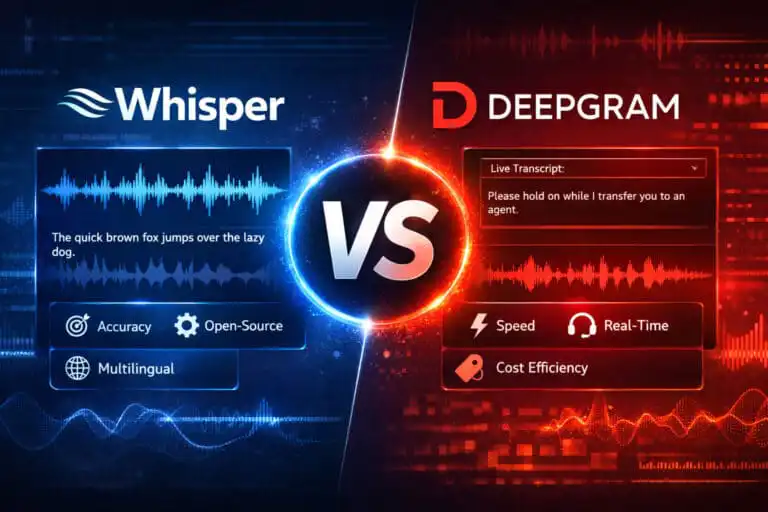
Its accuracy score is also strong at 9.3/10. Whisper still has the cleaner overall accuracy lead in our dataset, but Deepgram is the better product engine when speed, formatting, streaming and API ergonomics are the priority. For a direct head-to-head, see our Whisper vs Deepgram 2026 comparison.
Best for: AI voice agents, live captions, contact centres, real-time analytics and products where transcript delay is unacceptable.
Pros: class-leading streaming score, very fast, strong formatting, developer-friendly API, good cost efficiency.
Cons: slightly behind Whisper on raw accuracy, diarisation is strong but not top of the dataset, may be more platform-like than needed for simple offline transcription.
Deepgram Full Scores
- Accuracy: 9.3/10 ★★★★★★★★★★
- Speed: 9.9/10 ★★★★★★★★★★
- Speaker Detection: 9/10 ★★★★★★★★★★
- Punctuation: 9.4/10 ★★★★★★★★★★
- Diarization: 8.9/10 ★★★★★★★★★★
- Noise Robustness: 9/10 ★★★★★★★★★★
- Export Formats: 9.2/10 ★★★★★★★★★★
- Cost Efficiency: 9.2/10 ★★★★★★★★★★
- Real-time Streaming: 9.9/10 ★★★★★★★★★★
- Overall: 9.1/10 ★★★★★★★★★★
AssemblyAI – best for speech intelligence and structured extraction
AssemblyAI ranks third with an overall score of 9.0/10. It is the best fit when transcription is only the first step, and the real value lies in extracting topics, summaries, sentiment, actions, or structured information from audio.
This is where the market has changed. Many teams no longer want plain-text files. They want a transcript that can serve as CRM notes, support insights, coaching data, searchable knowledge, or a moderation signal. AssemblyAI is strongest when the workflow needs that layer of audio understanding built close to the transcription process.
Its scores are balanced: 9.2/10 for accuracy, 9.6/10 for speaker detection, 9.1/10 for diarisation and 8.9/10 for real-time streaming. That makes it less of a pure speed specialist than Deepgram, but more useful when the transcript needs to feed business analysis.
Best for: revenue operations, call analysis, media intelligence, content moderation, searchable audio archives and structured audio data extraction.
Pros: excellent speaker detection, strong speech intelligence features, good diarisation, strong API workflow for analysis-led use cases.
Cons: not the fastest streaming option, cost efficiency trails Deepgram slightly, may be more than needed for basic captions.
AssemblyAI Full Scores
- Accuracy: 9.2/10 ★★★★★★★★★★
- Speed: 8.9/10 ★★★★★★★★★★
- Speaker Detection: 9.6/10 ★★★★★★★★★★
- Punctuation: 9.2/10 ★★★★★★★★★★
- Diarization: 9.1/10 ★★★★★★★★★★
- Noise Robustness: 8.8/10 ★★★★★★★★★★
- Export Formats: 9/10 ★★★★★★★★★★
- Cost Efficiency: 8.5/10 ★★★★★★★★★★
- Real-time Streaming: 8.9/10 ★★★★★★★★★★
- Overall: 9/10 ★★★★★★★★★★
Speechmatics – best for global accents and multilingual transcription
Speechmatics ranks fourth overall with 8.8/10, but its strength is clearer than the rank suggests. It scores 9.4/10 for accuracy and 9.3/10 for diarisation, making it one of the safest options for accent-heavy and international audio.
This matters because English-language STT benchmarks can be misleading. A system that performs well on clean US English may struggle with regional British accents, non-native English, mixed speaker groups or industry-specific terminology. Speechmatics is built for that harder global use case.
The trade-off is that it does not lead to speed or cost efficiency in our dataset. It scores 8.5/10 for speed and 8.2/10 for cost efficiency. That is still good, but the decision is about reliability across varied speech rather than chasing the cheapest transcription minute.
Best for: broadcasters, global teams, multilingual archives, legal recordings, international customer research and accent-diverse audio.
Pros: excellent accuracy, top-tier diarisation, strong global accent handling, suitable for demanding professional audio workflows.
Cons: not the fastest or cheapest option; can be more specialist than required for simple English meeting notes.
Speechmatics Full Scores
- Accuracy: 9.4/10 ★★★★★★★★★★
- Speed: 8.5/10 ★★★★★★★★★★
- Speaker Detection: 8.8/10 ★★★★★★★★★★
- Punctuation: 9/10 ★★★★★★★★★★
- Diarization: 9.3/10 ★★★★★★★★★★
- Noise Robustness: 9.2/10 ★★★★★★★★★★
- Export Formats: 8.8/10 ★★★★★★★★★★
- Cost Efficiency: 8.2/10 ★★★★★★★★★★
- Real-time Streaming: 8.5/10 ★★★★★★★★★★
- Overall: 8.8/10 ★★★★★★★★★★
Azure AI Speech – best for Microsoft enterprise environments
Azure AI Speech ranks fifth with an overall score of 8.7/10. It is not the top-scoring tool for pure accuracy, but it remains one of the most sensible choices for organisations already standardised on Microsoft infrastructure.
That is the enterprise reality. Procurement, identity, compliance, logging, data residency, security review and existing Cloud architecture can matter as much as a small scoring difference. Azure AI Speech is the practical shortlist option when speech-to-text has to sit inside a Microsoft-native stack rather than a standalone transcription workflow.
Its scores are steady across the board: 8.9/10 for accuracy, 9.0/10 for speaker detection, 8.8/10 for diarisation and 8.7/10 for real-time streaming. It is not the most exciting tool on the table, but it is dependable in environments where governance matters.
Best for: Microsoft enterprise teams, regulated organisations, internal apps, compliance-sensitive transcription and Azure-native data pipelines.
Pros: strong enterprise fit, good speaker detection, reliable real-time and batch options, and easier governance for Microsoft customers.
Cons: not the best raw accuracy score, not as developer-light as some specialist APIs, less attractive if your stack is not already Azure-based.
Azure AI Speech Scores
- Accuracy: 8.9/10 ★★★★★★★★★★
- Speed: 8.7/10 ★★★★★★★★★★
- Speaker Detection: 9/10 ★★★★★★★★★★
- Punctuation: 8.8/10 ★★★★★★★★★★
- Diarization: 8.8/10 ★★★★★★★★★★
- Noise Robustness: 8.6/10 ★★★★★★★★★★
- Export Formats: 8.8/10 ★★★★★★★★★★
- Cost Efficiency: 8.4/10 ★★★★★★★★★★
- Real-time Streaming: 8.7/10 ★★★★★★★★★★
- Overall: 8.7/10 ★★★★★★★★★★
Google Gemini Flash STT – best for multimodal audio workflows
Google Gemini Flash STT ranks sixth, with an overall score of 8.6/10. Its strongest use case is not old-fashioned transcription in isolation. It is audio understanding within a broader multimodal workflow, where text, audio, video, context, and follow-up prompts may all matter.
Google scores well for speed and real-time streaming, each at 9.0/10. It also scores 9.2/10 in speaker detection, making it competitive for live and context-aware applications. Where Whisper is often the better finished-transcript engine, Gemini Flash STT is more interesting when transcription is part of an AI system that needs to understand the surrounding content.
We compare this route in more detail in our Whisper vs Google Speech-to-Text 2026 guide.
Best for: Google Cloud users, multimodal AI workflows, audio summarisation, video context, live products and teams already working with Gemini models.
Pros: high speed, strong speaker detection, useful within multimodal workflows, a good fit for Google-native infrastructure.
Cons: behind Whisper in finished transcript accuracy; diarisation is not top-tier; may be overkill for plain audio-to-text jobs.
Google Gemini Flash STT Scores
- Accuracy: 8.8/10 ★★★★★★★★★★
- Speed: 9/10 ★★★★★★★★★★
- Speaker Detection: 9.2/10 ★★★★★★★★★★
- Punctuation: 8.6/10 ★★★★★★★★★★
- Diarization: 8.5/10 ★★★★★★★★★★
- Noise Robustness: 8.4/10 ★★★★★★★★★★
- Export Formats: 8.6/10 ★★★★★★★★★★
- Cost Efficiency: 8.5/10 ★★★★★★★★★★
- Real-time Streaming: 9/10 ★★★★★★★★★★
- Overall: 8.6/10 ★★★★★★★★★★
Suno/Bark (STT) – best treated as a creative audio benchmark
Suno/Bark (STT) ranks seventh with an 8.2/10 overall score. This is the least conventional entry in the dataset, so it needs a careful reading. Treat it as a creative-audio benchmark rather than a direct replacement for enterprise speech APIs such as Deepgram, Azure, AWS or Rev AI.
Its scores are respectable: 8.5/10 for accuracy, 8.5/10 for speaker detection, 8.2/10 for noise robustness and 8.2/10 for real-time streaming. The weakness is not that it performs badly. The weakness is that it is not the most straightforward procurement or integration choice for standard business transcription.
Where it makes more sense is experimental audio work, creator tools, synthetic audio evaluation, voice-style workflows and projects where emotional or creative audio handling matters more than enterprise administration.
Best for: creative audio workflows, experimental transcription tests, synthetic speech projects and audio research.
Pros: useful creative-audio profile, solid speaker detection, good enough accuracy for non-enterprise experiments.
Cons: not the clearest business STT platform, weaker diarisation, weaker export score, less suitable for regulated transcription pipelines.
Suno/Bark (STT) Scores
- Accuracy: 8.5/10 ★★★★★★★★★★
- Speed: 8.2/10 ★★★★★★★★★★
- Speaker Detection: 8.5/10 ★★★★★★★★★★
- Punctuation: 8/10 ★★★★★★★★★★
- Diarization: 8/10 ★★★★★★★★★★
- Noise Robustness: 8.2/10 ★★★★★★★★★★
- Export Formats: 8/10 ★★★★★★★★★★
- Cost Efficiency: 8/10 ★★★★★★★★★★
- Real-time Streaming: 8.2/10 ★★★★★★★★★★
- Overall: 8.2/10 ★★★★★★★★★★
Otter.ai – best for meeting notes and collaboration
Otter.ai ranks eighth with an overall score of 8.1/10. It is not trying to be the best raw speech-to-text model or the fastest developer API. Its value is in the user workflow: meetings, shared notes, summaries, searchable conversations and collaboration.
That makes Otter.ai a strong choice for non-technical teams that want usable meeting records without building a pipeline. It scores 8.7/10 for diarisation and 8.8/10 for speaker detection, which is exactly where meeting software needs to be competent. The transcript does not just need to be accurate. It needs to be organised enough for people to use afterwards.
The limitation is control. Developers building products will usually prefer Deepgram, AssemblyAI, Azure, Google, AWS or Rev AI. Teams that mainly want better meeting memory may find Otter.ai simpler.
Best for: meeting notes, sales calls, team updates, interviews, lectures and collaborative transcript review.
Pros: easy for teams, good diarisation, strong meeting workflow, useful summaries and collaboration features.
Cons: not the strongest API-first choice, not the highest accuracy score, less flexible for custom product builds.
Otter.ai Scores
- Accuracy: 8.4/10 ★★★★★★★★★★
- Speed: 8.5/10 ★★★★★★★★★★
- Speaker Detection: 8.8/10 ★★★★★★★★★★
- Punctuation: 8.4/10 ★★★★★★★★★★
- Diarization: 8.7/10 ★★★★★★★★★★
- Noise Robustness: 8.2/10 ★★★★★★★★★★
- Export Formats: 8.2/10 ★★★★★★★★★★
- Cost Efficiency: 8.1/10 ★★★★★★★★★★
- Real-time Streaming: 8.5/10 ★★★★★★★★★★
- Overall: 8.1/10 ★★★★★★★★★★
AWS Transcribe – best for AWS data pipelines
AWS Transcribe ranks ninth with an 8.0/10 overall score. That rank can make it look weaker than it is. For a team already running audio storage, event handling, analytics and compliance inside AWS, Amazon Transcribe may still be the most operationally sensible choice.
Its scores are consistent rather than spectacular: 8.4/10 for accuracy, 8.4/10 for speed, 8.3/10 for diarisation and 8.5/10 for cost efficiency. This is the workhorse profile. It is not the tool most people would choose for the absolute best transcript, but it fits well into large AWS pipelines where architecture simplicity matters.
The main trade-off is that specialist providers tend to feel more focused. Deepgram is stronger for real-time agents. AssemblyAI is stronger for speech intelligence. Whisper is stronger for raw transcript quality. AWS Transcribe wins when the surrounding AWS ecosystem reduces friction.
Best for: AWS-native products, contact-centre pipelines, S3-based batch workflows, compliance-led infrastructure and large-scale enterprise transcription.
Pros: good AWS integration, reliable batch and streaming workflows, sensible cost efficiency, useful for large data pipelines.
Cons: not the best accuracy score, not the strongest diarisation, less compelling outside AWS-heavy environments.
AWS Transcribe Scores
- Accuracy: 8.4/10 ★★★★★★★★★★
- Speed: 8.4/10 ★★★★★★★★★★
- Speaker Detection: 8/10 ★★★★★★★★★★
- Punctuation: 8.2/10 ★★★★★★★★★★
- Diarization: 8.3/10 ★★★★★★★★★★
- Noise Robustness: 8.2/10 ★★★★★★★★★★
- Export Formats: 8.4/10 ★★★★★★★★★★
- Cost Efficiency: 8.5/10 ★★★★★★★★★★
- Real-time Streaming: 8.4/10 ★★★★★★★★★★
- Overall: 8/10 ★★★★★★★★★★
Rev AI – best for hybrid AI and human-reviewed transcription
Rev AI ranks 10th with an overall score of 7.9/10. It is still worth including because Rev has a different market position. It is strongest where machine transcription needs a path towards higher assurance, or where human review or caption workflows cannot tolerate messy output.
Rev AI scores 8.6/10 for export formats, its strongest category in our dataset. That fits the practical use case: captions, media files, formal transcripts and workflows where the output format matters. Its accuracy score is 8.2/10, which is respectable, but behind the leaders.
Choose Rev AI when the wider workflow matters more than chasing the highest model score. If you only want the strongest automated transcript, start higher in the table. If you want a bridge between AI speed and human-verifiable transcript work, Rev AI remains relevant.
Best for: captions, media transcription, human-reviewed workflows, formal transcript delivery and teams that value output formats.
Pros: strong export score, useful for media workflows, practical route into human-reviewed transcription, simple enough to test.
Cons: lowest overall score in this dataset, weaker noise robustness, weaker speaker detection than the leaders.
Rev AI Scores
- Accuracy: 8.2/10 ★★★★★★★★★★
- Speed: 8.3/10 ★★★★★★★★★★
- Speaker Detection: 7.9/10 ★★★★★★★★★★
- Punctuation: 8/10 ★★★★★★★★★★
- Diarization: 8.2/10 ★★★★★★★★★★
- Noise Robustness: 7.8/10 ★★★★★★★★★★
- Export Formats: 8.6/10 ★★★★★★★★★★
- Cost Efficiency: 7.8/10 ★★★★★★★★★★
- Real-time Streaming: 8.3/10 ★★★★★★★★★★
- Overall: 7.9/10 ★★★★★★★★★★
Which AI speech-to-text tool should you choose?
The best choice depends less on the brand name and more on the job the transcript has to do after it exists. A research team conducting interviews has a different problem from a product team building a live voice assistant. A compliance team has another problem.
| Use case | Best choice | Why |
|---|---|---|
| Highest overall transcript quality | OpenAI Whisper | Best overall score and highest accuracy score in the dataset. |
| Real-time AI voice agents | Deepgram | Top scores for speed and real-time streaming. |
| Call insights and structured audio data | AssemblyAI | Strongest fit for speech intelligence and extraction workflows. |
| Global accents and multilingual audio | Speechmatics | Excellent accuracy and diarisation for varied speech. |
| Microsoft enterprise deployment | Azure AI Speech | Best fit for Azure-native governance and enterprise controls. |
| Google-native multimodal products | Google Gemini Flash STT | Best when audio is part of a wider Gemini or Google Cloud workflow. |
| Creative audio experiments | Suno/Bark (STT) | Useful for experimental and creator-led audio workflows. |
| Meeting notes | Otter.ai | Best user-facing collaboration workflow in this dataset. |
| AWS pipeline integration | AWS Transcribe | Sensible for S3, AWS analytics and enterprise data pipelines. |
| Human-reviewed transcript workflows | Rev AI | Best fit where AI output may need review, captions or formal formatting. |
Buying guide: what matters before you choose
Do not buy on accuracy alone
Accuracy is the obvious metric, but it is not always the deciding metric. In a live agent, 9.3/10 accuracy with lower latency may beat 9.6/10 accuracy with slower response. In a legal transcript, the opposite may be true. In a meeting tool, speaker separation may matter more than another small gain in word-level accuracy.
Check whether you need batch or streaming transcription
Batch transcription is easier. You upload a file, process it and receive a result. Streaming transcription is harder because the system has to handle partial words, pauses, interruptions, network jitter, and speaker changes while the audio is still being recorded.
For batch jobs, OpenAI Whisper, Speechmatics, AWS Transcribe, Rev AI and AssemblyAI all make sense depending on the surrounding workflow. For streaming-first products, Deepgram should be tested early. Google Gemini Flash STT and Azure AI Speech are also strong when the product already sits in their Cloud ecosystems.
Think about diarisation before you need it
Diarisation is easy to ignore until you have a transcript where three people are mixed. For interviews, board meetings, sales calls, podcasts and customer research, speaker labels can save more editing time than a small improvement in raw word accuracy.
Speechmatics, OpenAI Whisper, AssemblyAI, Azure AI Speech and Otter.ai are the strongest diarisation performers in this dataset. The right choice depends on whether you need API control, meeting UX or global accent coverage.
Be honest about the hidden cost of self-hosting
Self-hosted transcription can look cheap on paper. In practice, the cost includes GPUs, queues, monitoring, retries, storage, model updates, developer time, and operational support. That can still be worth it, especially for privacy-sensitive or high-volume workflows, but it is not automatically cheaper.
For a closer look at the cost side, see our guide to OpenAI Whisper API pricing in 2026.
Use official documentation before building production systems
Before committing to a provider, check its supported languages, data retention rules, streaming limits, SDK coverage, caption formats, deployment options and pricing model. For OpenAI-specific implementation details, the OpenAI speech-to-text documentation is the safest starting point.
What has changed in AI speech-to-text since 2025?
The biggest change is that transcription is no longer treated as the end product. In 2025, many buyers still asked, “Which tool gives the cleanest transcript?” In 2026, the better question is, “What can this transcript do inside my workflow?”
That shift explains the rankings. OpenAI Whisper stays first because accuracy, noise handling and transcript quality still matter. Deepgram nearly catches it because real-time streaming is now critical for AI agents. AssemblyAI is close behind because many teams want structured output, not just text. Speechmatics remains important because global speech is still harder than demo audio.
The lower-ranked tools are not irrelevant. Otter.ai is still easier for meetings than most API products. AWS Transcribe is still a sensible default inside AWS. Rev AI still has a role in human-reviewed transcript workflows. The mistake is treating all speech-to-text tools as if they solve the same problem.
Final verdict: the best AI speech-to-text tool for most users
OpenAI Whisper is the best overall AI speech-to-text tool in our 2026 dataset, with the highest combined score and the highest accuracy rating. It is the first tool to test when transcript quality matters most.
Deepgram is the better choice for real-time voice systems. AssemblyAI is the better choice when you need speech intelligence and structured audio extraction. Speechmatics is the right shortlist pick for global accents. Azure AI Speech, Google Gemini Flash STT and AWS Transcribe make the most sense when their Cloud ecosystems reduce operational friction.
For most buyers, the right decision is not “Which tool is famous?” It is: will the transcript be edited by humans, read by customers, used by an AI agent, pushed into analytics, attached to a meeting, or stored as regulated business data? Answer that first, and the shortlist becomes much clearer.
FAQs
What is the best AI speech-to-text tool in 2026?
OpenAI Whisper is the best overall AI speech-to-text tool in our 2026 dataset, with an overall score of 9.2/10 and the highest accuracy score of 9.6/10. Deepgram is a better choice for real-time streaming and AI voice agents.
Which speech-to-text tool is the fastest?
Deepgram is the fastest tool in this dataset, scoring 9.9/10 for speed and 9.9/10 for real-time streaming. It is the strongest choice for live captions, conversational AI and voice products where delay affects the user experience.
Is OpenAI Whisper still worth using?
Yes. Whisper remains one of the best options for accurate transcription, especially for long-form audio, interviews, noisy recordings and developer-controlled workflows. The main reason to choose another tool is not that Whisper is weak. It may be that your use case needs lower latency, built-in analytics, or enterprise Cloud controls.
What is the best speech-to-text tool for meetings?
Otter.ai is the simplest meeting-focused option in this dataset because it is built around shared notes, speaker labels, summaries and collaboration. If you are building a custom meeting product rather than using a finished app, AssemblyAI, Deepgram, or Azure AI Speech may be better fits.
What is diarisation in speech-to-text?
Diarisation is the process of identifying who spoke each part of a transcript. It matters in meetings, interviews, podcasts, sales calls and customer research because a transcript without speaker labels can be hard to use even when the words are accurate.
Which AI speech-to-text tool is best for developers?
Deepgram is the strongest developer choice for real-time streaming. AssemblyAI is strong for developers who need speech intelligence. OpenAI Whisper is best for developers who want accuracy, control and flexible deployment. AWS Transcribe, Azure AI Speech and Google Gemini Flash STT are strongest when the surrounding Cloud platform is already part of the product.
Should medical, legal or compliance transcripts use AI only?
Not usually. AI transcription can reduce manual work, but high-risk transcripts should still be subject to review controls. Legal, healthcare, financial and compliance workflows need a process for checking names, numbers, technical phrases, speaker labels and any section where a transcription error could change meaning.