Search Atlas Review 2026: 9.0/10, OTTO SEO and Free Trial
Search Atlas is one of the most ambitious AI SEO platforms in 2026. Rather than stopping at keyword research, audits and content scores, it is built around a harder problem: turning SEO findings into approved changes that can actually be implemented on a live site.
DIY AI scores Search Atlas 9.0/10 overall in our updated SEO dataset. Its strongest results are Technical SEO & Automation at 9.8/10, AI Writing & Workflow Automation at 9.6/10 and AI Search Visibility & Citation Intelligence at 9.2/10. Those scores explain the appeal of OTTO SEO, Content Genius, and the wider automation layer, but they do not eliminate the need for careful approval, QA, and implementation controls.
This Search Atlas review focuses on what matters before adopting it: what OTTO actually changes, how Content Genius fits into an editorial workflow, how useful AI visibility is, what to test during the current 7-day trial, where Search Atlas still falls short for agencies and which alternatives make more sense when implementation is not your main bottleneck.
Search Atlas review verdict: 9.0/10
| DIY AI score | 9.0/10 |
| Star rating | 4.5/5 |
| Best for | Agencies, publishers and in-house teams that want SEO research, content, technical work and implementation connected in one platform |
| Best feature | OTTO SEO, because it can move beyond recommendations into controlled deployment |
| Key limitation | Automation can scale a poor approval or implementation decision across several pages or sites very quickly |
| Biggest operational risk | Assuming automated changes are correct because they have already passed through the software |
| Should you trial it? | Yes. Test Search Atlas on one low-risk live project before migrating a mature SEO stack |
Start the Search Atlas 7-day trial and use it on one real site rather than spending the week clicking through dashboards.
 DIY AI dataset scorecard
Search Atlas
Scored across 11 practical DIY AI dataset metrics.
- Keyword Intelligence8.9/10★★★★★★★★★★
- Content Optimization8.9/10★★★★★★★★★★
- SERP Analysis Depth8.9/10★★★★★★★★★★
- AI Search Visibility & Citation Intelligence9.2/10★★★★★★★★★★
- Technical SEO & Automation9.8/10★★★★★★★★★★
- Data Freshness8.6/10★★★★★★★★★★
- ROI Value9/10★★★★★★★★★★
- Reporting Features8.6/10★★★★★★★★★★
- AI Writing & Workflow Automation9.6/10★★★★★★★★★★
- Integration Ease8.3/10★★★★★★★★★★
- Collaboration8.3/10★★★★★★★★★★
Search Atlas scores in DIY AI’s updated 11-metric dataset
The current score is based on DIY AI’s published data framework and the dedicated AI SEO tools dataset. The methodology measures 11 areas, including AI search visibility, technical automation and workflow automation, rather than treating AI writing as the only modern capability.
| DIY AI metric | Search Atlas score | What the score means in practice |
|---|---|---|
| Keyword Intelligence | 8.9/10 | Strong keyword discovery, clustering and competitor opportunity work without being the deepest specialist keyword database. |
| Content Optimisation | 8.9/10 | Strong briefs, page analysis, topical coverage and refresh workflows. |
| SERP Analysis Depth | 8.9/10 | Useful competitive context across keywords, pages and sites. |
| AI Search Visibility & Citation Intelligence | 9.2/10 | Tracks mentions, citations, share of voice, topics and competitor visibility across AI search experiences. |
| Technical SEO & Automation | 9.8/10 | The standout result. OTTO can identify work and deploy many approved on-page and technical changes. |
| Data Freshness | 8.6/10 | Strong enough for active campaign management, though not the main reason to choose Search Atlas over a specialist research database. |
| ROI Value | 9.0/10 | Strong when the platform genuinely replaces subscriptions or removes implementation labour. |
| Reporting Features | 8.6/10 | Useful multi-source and white-label reporting for agencies and portfolio teams. |
| AI Writing & Workflow Automation | 9.6/10 | Content planning, drafting, optimisation and publishing sit unusually close to the wider SEO execution layer. |
| Integration Ease | 8.3/10 | Broad deployment options, but setup deserves more care than a reporting-only SEO tool. |
| Collaboration | 8.3/10 | Solid team and agency workflow support without becoming a dedicated project-management system. |
| Overall | 9.0/10 | First place in the current DIY AI SEO dataset. |
The 9.0 score should not be read as “Search Atlas has the best data in every category”. It does not. The score reflects operating value across the whole workflow. Search Atlas gains most of its advantage once an opportunity is identified, as it can help turn the recommendation into an implemented change.
What is Search Atlas?
Search Atlas is an AI SEO and marketing platform covering keyword research, site exploration, backlinks, technical auditing, content optimisation, rank tracking, local SEO, AI search visibility, reporting and automation. Its best-known product is OTTO SEO, an execution layer designed to scan a site, recommend work and deploy approved changes.
That makes Search Atlas different from a dashboard that simply produces another audit. The platform is trying to become the operating layer around the work: identify a problem, decide what to do, execute the change, monitor the result and feed the next action back into the system.
The benefit is obvious for a lean team with a large backlog. The hidden risk is equally important. Once SEO software can write to a CMS, alter live output or automate off-page work, permissions and review rules become part of the product decision.
OTTO SEO review: why Search Atlas scores 9.8/10 for technical SEO and automation
OTTO SEO is the main reason Search Atlas ranks so highly. Plenty of SEO tools can identify missing metadata, weak internal links, broken URLs or schema problems. OTTO is designed to shorten the distance between identifying the issue and getting an approved change live.
What OTTO SEO can change
Current OTTO workflows cover technical and on-page work such as titles, metadata, headings, alt text, schema, canonical URLs, broken links, redirects and internal links. The broader automation landscape extends to content creation, local SEO, authority work, digital PR, and indexing.
The useful part is not the raw number of actions. It is that low-risk tasks can be moved out of a manual ticket queue. A team that already agrees that a title is weak or that an internal link is missing gains little by exporting that finding to another spreadsheet and waiting several days for someone else to implement it.
Can OTTO change headings or content without your approval?
OTTO can make on-page and content changes if those automations are enabled. That does not mean a professional team should allow every recommendation to deploy automatically. Search Atlas provides approval controls, individual editing, bulk actions and rollback options.
I would separate actions into risk tiers. Missing alt text and straightforward metadata can usually move through review more quickly. Heading rewrites, internal-link changes, schema, canonicals, redirects and modifications to commercial-page copy deserve a named reviewer. The useful question is not whether AI can make a change. It is who owns the result if that change turns out to be wrong.
OTTO Pixel, CMS connectors and where changes actually live
Older descriptions of OTTO as purely a JavaScript injection layer are now too simplistic. Search Atlas says its current OTTO SEO deployment options can include an edge layer, direct CMS connections and code-pipeline routes, alongside its own preservation mechanisms.
That Flexibility creates an implementation question many feature comparisons miss: where does each change actually live? An agency should document whether an important optimisation is applied at the edge, written into the CMS, deployed through code or dependent on a Search Atlas mechanism. You do not want to discover the ownership model during a client handover, migration or emergency rollback.
The real-world OTTO limitation is trust, not feature count
The recurring pattern in practitioner feedback is not that OTTO lacks ideas. It is that deployment trust, integration stability, reporting and support can determine whether those ideas save time or create more review work. Some users value the speed and execution model. Others have reported problems serious enough that they kept established SEO tools running alongside Search Atlas.
That produces a useful operating rule: do not judge OTTO by the demo, and do not grant broad control on day one. Start with one site, keep approval enabled, compare visible changes with the CMS and source output, then widen permissions only after the workflow has proved predictable.
This is also a limitation of any feature-led dataset score. Our 9.8 Technical SEO & Automation result measures capability and operating potential. It does not mean every implementation will be error-free or that support quality will be identical for every customer.
Does Search Atlas have content automation? Yes, and it is now one of its strongest areas
Search Atlas scores 9.6/10 for AI Writing & Workflow Automation. Content Genius can support content planning, topical maps, briefs, article generation, optimisation and refresh work, while the wider platform can publish content into connected CMS platforms.
| Content job | Where Search Atlas helps | Where a human still matters |
|---|---|---|
| New article planning | Topic maps, keyword targets, competitor coverage and content plans | Choosing whether the page deserves to exist and avoiding cannibalisation |
| First draft | AI-generated article structure and copy using project context | Original analysis, source checking, examples and brand judgement |
| Existing-page refresh | Finds coverage gaps, weak sections, internal-link opportunities and optimisation targets | Diagnosing whether a decline is really a content problem rather than intent, links or technical issues |
| Publishing | CMS publishing can reduce hand-offs | Final factual, legal, editorial and conversion review |
The strongest use case is not generating hundreds of new pages. It is shortening the refresh loop on content that already has evidence of demand. If a page has impressions, slipping rankings or an obvious content gap, Search Atlas can bring research, editing and publishing closer together.
The failure mode is volume without selectivity. A platform that can plan, write and publish quickly also makes it easier to scale a weak topic decision. Measure how much generated work survives editing and contributes to a deliberate site structure, not how many articles the monthly allowance makes possible.
Search Atlas LLM Visibility: what the 9.2/10 score actually buys you
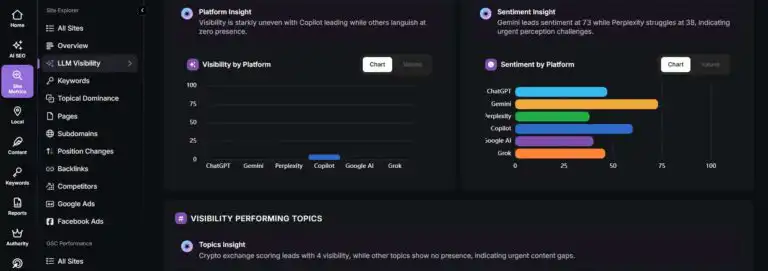
Search Atlas treats AI search visibility as part of the wider SEO workflow rather than as an isolated novelty dashboard. The platform can monitor brand appearances, citations, share of voice, topics, sentiment and competitor visibility across major AI search experiences.
Plan boundaries affect access. Growth introduces AI visibility across ChatGPT, Gemini, and Google AI Mode, while Pro further expands platform coverage. That matters because a buyer primarily interested in AI-search monitoring should evaluate the plan that includes that capability rather than judging Search Atlas solely by its cheapest entry tier.
The harder problem is measurement stability. AI answers can vary by prompt wording, model, location and repeated runs. I would not rewrite a site because one tracked question changed position. Use a stable prompt set, monitor citation and competitor trends over time, and track conventional search performance alongside AI visibility data.
Search Atlas free trial in 2026: what to test during the 7 days
Search Atlas currently offers a 7-day trial on its self-serve plans and promotes free one-to-one onboarding. A week is enough to evaluate the product if you arrive with a test plan. It is not enough if the first few days disappear into exploring menus.
Choose four jobs: one OTTO technical fix, one content refresh, one reporting workflow and one AI-visibility check. Record how much manual work remains, whether the recommendations are sensible and exactly where any deployed changes live.
Before starting, confirm the renewal and cancellation details shown at checkout and add the end of the trial to your calendar. The goal is to evaluate Search Atlas as a production system, not discover the billing mechanics after the evaluation window has closed.
Search Atlas plans at a glance
The review only needs enough information about the plan to judge product fit. Search Atlas currently has four main tiers, with higher plans adding more projects, seats, execution capacity, AI visibility coverage and agency features.
| Plan | Current monthly price | Projects | Seats | Main fit |
|---|---|---|---|---|
| Starter | $99 | 1 | 1 | One brand or operator using the core Search Atlas and OTTO workflow |
| Growth | $199 | 2 | 3 | Teams that need AI visibility and more working capacity |
| Pro | $399 | 4 | 5 | Agencies needing broader AI coverage and white-label reporting |
| Agency / Enterprise | From $999 | 10+ | 10 | Larger client portfolios requiring substantially more capacity |
Plan snapshot checked 4 September 2026. The right tier is not determined by company size alone. Active OTTO projects, Universal Credit consumption, seats and AI visibility requirements can materially change the configuration a team needs.
For annual billing, Universal Credits, additional OTTO capacity, and worked examples for 1, 5, 20, and 50 active sites, use our dedicated Search Atlas pricing guide. Detailed cost modelling is deliberately excluded from this review, so the two pages answer different questions.
Does Search Atlas have an API and Rapid URL Indexer?
Yes. Search Atlas provides API capabilities around parts of its content and indexing environment, including page data, bulk content inputs and indexer reporting. Its indexing tools can track submitted and indexed URLs rather than simply treating submission as proof that a URL has entered the index.
The practical warning is to validate API coverage against the exact workflow before a development team builds around it. Do not assume every dashboard feature has an equivalent endpoint, and do not treat an indexing submission as a guarantee that Google will retain a URL. Search engines still decide what gets crawled, indexed and kept.
How good is the Search Atlas backlink analyser?
Search Atlas is no longer easy to dismiss as weak in terms of backlinks. Site Explorer and Backlink Analyzer cover referring domains, anchors, link attributes, spam signals, historical profile information and competitor gaps. The wider authority layer also connects backlink research with outreach and distribution workflows.
That is enough for many agencies that want routine backlink analysis besides content, technical SEO and reporting. I would still keep a specialist research tool during migration if link forensics, digital PR prospecting or deep historical backlink analysis accounts for a large part of the retainer.
The sensible test is not whether Search Atlas displays backlinks. Almost every serious platform can do that. Check whether it finds the referring domains your team already considers important, whether historical changes are visible early enough to diagnose a problem and whether the competitor gap data changes a real outreach decision.
Search Atlas reporting and white-label features are useful, but reliability matters more than dashboard design
Search Atlas can combine rank tracking, analytics, search performance, backlink data, local visibility, and content data into a reporting environment. Higher plans add white-label and client-facing capabilities that are more relevant to agencies than solo site owners.
Reporting is also one of the areas I would test hardest during the trial. Practitioner feedback is mixed, and a visually strong dashboard still fails an agency if account managers do not trust the numbers or have to reconcile reports against first-party sources every month.
Build one report for a real account. Compare it with the sources your team already relies on. Then ask how many manual steps remain before the report could genuinely replace the existing process.
What Search Atlas still gets wrong for agencies despite the 9.0/10 score
Search Atlas has a strong agency proposition, but its weaknesses are mostly operational rather than obvious gaps on the checklist.
| Agency limitation | Why it matters | How I would manage it |
|---|---|---|
| Automation governance | A bad rule can spread across several client sites much faster than a manual mistake | Use approval mode, risk tiers, named owners and rollback testing before wider deployment |
| Reliability and support need live validation | Practitioner feedback is mixed around reporting, integrations, onboarding and support | Run the exact production stack during the trial rather than committing from a demo |
| Specialist research depth | Broad coverage does not automatically replace a deep backlink or enterprise intelligence workflow | Keep a specialist tool only where the missing depth changes billable decisions |
| Project capacity | The number of simultaneously active automated sites can become more important than total client count | Separate the agency roster from the active automation roster |
| Training surface | OTTO, content, local SEO, AI visibility, authority, ads and reporting create a large operating surface | Create a short SOP for each role instead of giving every user access to every automation |
| Change ownership | Agencies need to know what survives a cancellation, migration or client handover | Document whether important changes live in the CMS, code, edge layer or platform-controlled workflow |
The most useful buying question is therefore not “does Search Atlas have the feature?”. It usually does. Ask how reliably that feature works in your stack, who approves its output and whether the client can leave without creating a technical clean-up project.
Best Search Atlas alternatives in 2026
The best Search Atlas alternative depends on which part of Search Atlas you do not need. Buying another broad SEO suite simply because it has a similar feature list can leave the original workflow problem untouched.
| Alternative | DIY AI overall score | Choose it instead when… | What you give up versus Search Atlas |
|---|---|---|---|
| Ahrefs | 8.7/10 | Backlink research, competitor discovery and evidence-led SEO research are the centre of the workflow | Less direct execution from recommendation to live change |
| Frase | 8.4/10 | Your main problem is research, briefs, writing, optimisation and publishing rather than full-site SEO operations | Much less backlink and broad competitive intelligence |
| SurferSEO | 8.1/10 | You want a focused content optimiser for writers and editors | Technical SEO, authority work, reporting and site-wide automation |
| AirOps | Not scored in this dataset | You already have SEO data and need governed content and AI-search workflows at scale | A broader all-in-one SEO research, technical, local and backlink operating layer |
Search Atlas vs Ahrefs
Ahrefs is the stronger alternative when the work starts with backlink intelligence, competitor analysis and deeper research. Search Atlas is the stronger fit when the expensive part of the workflow happens after the research and the team needs more help implementing the work.
A link-led agency can therefore reasonably prefer Ahrefs even though Search Atlas has the higher overall DIY AI dataset score. Overall scores should not override the specific job that creates revenue.
Search Atlas vs AirOps
AirOps overlaps with Search Atlas around AI-search optimisation, content workflows and publishing, but they are not direct substitutes. AirOps is more of a content and AI search execution environment for teams that already have research and analytics inputs. Search Atlas is broader, with keyword research, site audits, backlinks, rank tracking, local SEO, reporting, and technical deployment all within the same product.
Choose AirOps if the existing SEO stack is strong and the missing layer is governed content production. Choose Search Atlas if the goal is to consolidate more of the SEO operating stack itself.
OTTO PPC review: Smart Ads is useful, but it is not why I would buy Search Atlas
Search Atlas now packages Smart Ads, previously discussed as OTTO PPC, alongside the wider platform. It covers paid campaign generation, publishing, reporting, landing pages and automation.
I would treat this as an additional capability rather than the primary reason for buying. Paid search has a different cost of failure than SEO. A poor content suggestion can be caught before publication. A badly automated ad decision can spend money immediately.
Test one contained campaign with strict budgets and independent conversion tracking before allowing broader automation. Do not use the success of OTTO’s technical SEO workflow as evidence that paid-media automation deserves the same permissions.
Is Search Atlas a reputation management tool?
Not primarily. Search Atlas is an SEO and marketing platform, not a specialist online reputation management system. Its local SEO tools can handle parts of the reputation workflow, including Google Business Profile activity and review-related tasks.
That is useful for local SEO retainers, but it should not be confused with a dedicated reputation platform built around review acquisition, case handling, multi-location sentiment operations or customer-service escalation. If reputation management is the main service, evaluate that workflow separately rather than assuming the local SEO module replaces it.
Search Atlas pros and cons
| Pros | Cons |
|---|---|
| 9.0/10 overall score in the current DIY AI SEO dataset | The breadth of automation creates more ways for a weak approval process to cause problems |
| Excellent 9.8/10 Technical SEO & Automation score | Specialist backlink or enterprise research teams may still prefer a dedicated research platform |
| 9.6/10 AI Writing & Workflow Automation with direct publishing options | Content and technical output still needs knowledgeable review |
| AI-search visibility is integrated with wider SEO work rather than isolated in a separate dashboard | Full AI visibility is not included at the cheapest entry tier |
| Strong reporting and agency capabilities at higher tiers | Project and automation requirements can make configuration more complicated than the headline plan table suggests |
| Can consolidate several SEO subscriptions and implementation hand-offs | Mixed practitioner experiences make a live trial more important than the feature list |
See more of our reporting in Google Top Stories, AI Overviews and AI Mode.
Who should use Search Atlas?
Search Atlas is a strong fit for: lean SEO agencies with more implementation work than staff, publishers refreshing a large existing content library, local SEO teams handling recurring GBP work and in-house teams that want technical and content changes to move faster without opening a separate developer ticket for every minor fix.
Search Atlas is a weaker fit for: teams that mainly need backlink forensics; organisations with strict code-only deployment rules and no appetite for an external execution layer; very small sites that will use only a fraction of the product; and businesses that want automation but have nobody qualified to review what it does.
There is also a middle group: agencies that like OTTO but already have a mature research stack. They should not force consolidation. Search Atlas can be valuable as an execution layer even if another tool remains the preferred source for a specialist research task.
A practical 7-day Search Atlas evaluation plan
- Day 1 – establish the baseline. Connect one site and the first-party data sources you use. Record current rankings, known technical issues and one page that needs a refresh.
- Day 2 – test OTTO in approval mode. Review ten recommendations and separate useful fixes from low-priority noise. Deploy only one low-risk change.
- Day 3 – test rollback and ownership. Reverse the change, then confirm where the update lived and what would happen if Search Atlas were removed from the workflow.
- Day 4 – run a content refresh. Use Content Genius on an existing page. Count how many recommendations improve the page and how many would simply add generic wording.
- Day 5 – build one report. Recreate the report your team or client already receives. Measure how much manual assembly remains.
- Day 6 – test AI visibility and backlinks. Check whether the data is detailed enough to change a real decision rather than merely create another dashboard.
- Day 7 – calculate replacement value. List the tools and manual steps Search Atlas could genuinely remove. Keep anything you still need in the real comparison.
This trial tells you more than a feature checklist. Search Atlas is valuable when it removes hand-offs without removing control. If the team spends the week second-guessing every number or rebuilding every output elsewhere, consolidation has not actually happened.
A better way to judge OTTO: measure accepted changes, not generated recommendations
Automation dashboards naturally reward volume. More issues found, more fixes suggested, and more tasks completed all look productive. That can be misleading.
The better operating metric is the percentage of recommendations that a knowledgeable reviewer accepts and keeps. If OTTO produces 100 suggestions but only 20 survive review, the workload has not been reduced as much as the activity counter suggests. If 80 of 100 are sensible and low-risk, the implementation advantage becomes much more convincing.
I would track four numbers during the trial:
- Recommendations reviewed
- Recommendations accepted
- Human review time
- Changes later reversed or corrected
That produces an acceptance rate and a clean-up rate. Both are more useful for evaluating agentic SEO than the number of automated actions the product says it can perform.
The hidden Search Atlas cost is QA time, even when the subscription looks reasonable
The operational cost of Search Atlas is not limited to the subscription. An automated workflow can save several hours of implementation while quietly creating several hours of review, reconciliation and clean-up.
This is why the product should be tested against your current process rather than against a feature checklist. Record how long an experienced person spends approving changes, checking reports and correcting rejected output. If that time remains high after onboarding, the automation layer is not removing as much labour as expected.
The point is not to demand zero review. That would be unrealistic for software that changes the search-facing parts of a commercial website. The goal is to move knowledgeable people away from repetitive implementation and towards higher-value decisions without allowing quality control to disappear.
Search Atlas review FAQs
What is Search Atlas used for?
Search Atlas is used for keyword and competitor research, technical audits, content optimisation, rank tracking, backlink analysis, local SEO, AI search visibility, reporting, and automated SEO implementation. OTTO SEO is the execution layer that most clearly separates it from traditional reporting-first SEO software.
What is OTTO SEO?
OTTO SEO is Search Atlas’s AI automation system. It can analyse a site, recommend changes and deploy approved technical, on-page, content, local and authority-related work through several connection methods. DIY AI scores Search Atlas 9.8/10 for Technical SEO & Automation.
Does Search Atlas have a free trial?
Yes. Search Atlas currently advertises a 7-day trial on its self-serve plans, with one-to-one onboarding also promoted. Use the trial on a real site, and confirm the renewal and cancellation terms at checkout before starting.
Which Search Atlas plans include OTTO SEO?
OTTO SEO is included across Search Atlas’s current main plans, with the number of included projects and wider feature allowances increasing at higher tiers. For current plan prices, annual billing, credits and multi-site cost examples, use the dedicated Search Atlas pricing guide linked earlier in this review.
Is Search Atlas legit?
Yes. Search Atlas is an established commercial SEO platform with active products covering research, automation, content, reporting and local SEO. The more useful question is whether its integrations, support and automation are reliable enough for your own workflow. Practitioner feedback is mixed, so test it on a low-risk live site before rolling it out across the entire agency stack.
Is Search Atlas better than Ahrefs?
Search Atlas is stronger for execution-led SEO workflows and scores 9.0/10 overall in the current DIY AI dataset. Ahrefs scores 8.7/10 and remains a strong choice for teams whose main work is backlink intelligence, competitor research and evidence-heavy analysis. The better product depends on whether research depth or implementation capacity is the real bottleneck.
Is AirOps better than Search Atlas?
AirOps is better suited to teams that already have SEO and analytics data but need an AI-search and content execution workflow with governance for large-scale publishing. Search Atlas is a broader SEO platform that includes keyword research, audits, backlinks, local SEO, rank tracking, reporting and technical deployment in one system.
Is Search Atlas Content Genius enough for publishing?
Content Genius can handle much of the research, drafting, optimisation and publishing workflow, but it should not be the final editorial authority. Claims, examples, tone, originality and commercial judgement still need human review, particularly on high-value or expert-led pages.
Does Search Atlas have an API?
Yes. Search Atlas provides API capabilities around parts of its content and indexing workflows. Teams planning a custom integration should confirm the exact endpoints, quotas and permissions they need before committing development time.
Is OTTO SEO safe?
OTTO is safest when approval, rollback and risk-based change controls are used. Low-risk changes can be reviewed quickly. Canonicals, redirects, schema, navigation, important internal links and commercial-page content deserve a stricter release process.
Does OTTO SEO directly update WordPress?
Search Atlas now supports several deployment approaches, so the answer depends on the connection method being used. Do not assume every optimisation is written into the same WordPress field. Confirm where titles, schema, links and other changes live before rolling OTTO across client sites.
Is SearchAtlas the same as Search Atlas?
Yes. SearchAtlas is a commonly used combined spelling of the Search Atlas SEO platform. It is unrelated to MongoDB Atlas Search.
Final verdict: Search Atlas is worth testing if implementation is your bottleneck
Search Atlas earns its 9.0/10 DIY AI score because it covers more of the journey from SEO evidence to completed work than most all-in-one platforms. OTTO is the clearest advantage. Content Genius has evolved into a serious workflow layer, while AI-search visibility, reporting, backlinks, and several deployment routes make the platform much more than an AI writing tool with an attached SEO dashboard.
The caveat is operational trust. Search Atlas can save labour only if your team trusts the relevant data, understands where changes live and has a review process that prevents automation from scaling the wrong decision. Mixed practitioner experiences with integrations, reporting, and support are reason enough to avoid a blind migration.
Use the 7-day trial on one real project and measure the number of accepted recommendations, implementation time, manual clean-up, and how many existing workflow steps the platform genuinely removes. If those numbers improve, Search Atlas can justify replacing several disconnected processes. If the team keeps checking every output elsewhere, the 9.0 score will not translate into 9.0 value for your workflow.
You Might Also Like:

AI Visibility Monitoring Tools

Best AI SEO Tools

AI Content Gap Analysis Tools