Best AI Voice Detectors in 2026: Deepfake and Synthetic Speech Tools Tested
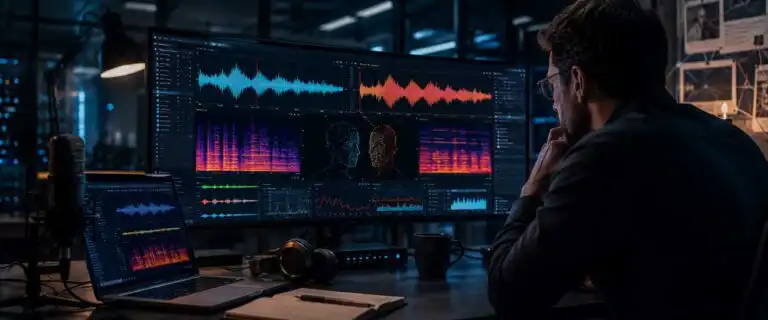
Resemble Detect is the strongest AI voice detector for organisations that need real-time analysis, API access and explainable results. Reality Defender is the more accessible starting point for developers, as it includes 50 free audio or image scans per month. DeepFake-O-Meter is the best free research-led option for comparing several detection models, while ElevenLabs Audio Detector is the most useful provenance checker when a recording may have been generated by ElevenLabs.
No AI voice detector can prove that a recording is genuine. A result is a probability produced under particular conditions, not a forensic certificate. Accuracy can change when the audio is compressed, shortened, mixed with music, played through a speaker, recorded over a telephone connection or generated by a model the detector has not seen before.
This guide evaluates public upload tools, browser extensions, APIs and enterprise fraud systems using a detection-specific methodology. It does not reuse the DIY AI audio-generation dataset because realistic voice generation and reliable synthetic-speech detection are different technical problems.
Quick verdict: Use Resemble Detect for a production detection system, Reality Defender for a self-serve developer API, DeepFake-O-Meter for a free multi-model second opinion and ElevenLabs Audio Detector when you specifically need to check for ElevenLabs provenance. For a suspicious payment request or emergency call, do not rely on any detector alone. End the call and verify the person through a separate trusted channel.
Best AI voice detectors at a glance
| Tool | Best for | Access | Result type | Critical limitation |
|---|---|---|---|---|
| Resemble Detect | Best overall production detector | API, browser upload, streaming and on-premises deployment | Verdict, confidence and explainable segment analysis | Pricing is aimed at organisations rather than occasional users |
| Reality Defender | Best self-serve developer API | Free API plan and paid business tier | Audio analysis with explainability on paid plans | Cross-tool benchmark results have varied considerably by test set |
| DeepFake-O-Meter | Best free research-led second opinion | Free web platform with account | Results from several independent detection models | Models may disagree, and it is not designed for live fraud prevention |
| ElevenLabs Audio Detector | Best for ElevenLabs provenance | Free web detector | Checks for ElevenLabs SynthID watermark evidence | It is not a universal detector for every synthetic voice platform |
| Pindrop Pulse | Best for call centres and live voice fraud | Enterprise deployment, API and inspection tools | Real-time risk score and segment-level analysis | Custom pricing and little value for occasional file checks |
| Hive AI detection | Best for moderation platforms | API, web demonstration and moderation workflow | Probability scores across audio and other media | Public pricing and audio-specific benchmark detail are limited |
| Aurigin | Best voice-only real-time API | REST API, WebSocket and SDK integrations | Real or synthetic classification with optional voice matching | Designed for product integration rather than casual investigation |
| NordVPN AI Voice Detector | Best private browser checker | Free Chrome extension | Human, possible deepfake or AI-generated warning | Checks audio playing in a browser tab, not ordinary telephone calls |
| Hiya Deepfake Voice Detector | Best for telecom and mobile-call protection | Free browser extension and commercial network integrations | Live synthetic-voice warnings | Consumer access differs from the technology supplied to operators |
| DeepfakeDetector.ai | Best self-serve tool with public pricing | Free web plan, paid subscriptions and API | AI or human verdict with a confidence-style TrustScore | Its accuracy claims need more independent cross-tool validation |
This category should not be confused with conventional AI detection tools for text. Text detectors analyse statistical writing patterns. Voice detectors work with acoustic, spectral, temporal and generator-related signals inside an audio recording.
An AI voice detector result is not forensic proof
Most consumer tools reduce a complicated analysis to a percentage or a binary label. That is convenient, but it can hide the conditions under which the model works.
A detector can return a high synthetic probability because it recognises artefacts associated with a known speech generator. It may also react to telephone compression, aggressive noise reduction, an unusual microphone, a non-native accent or an editing process that resembles its training examples.
The opposite failure is equally dangerous. A detector may classify a deepfake as human because the generator is new, the audio has been transformed, or the model was trained on clean synthetic speech rather than real scam recordings.
| Detector result | What it can reasonably mean | What it does not prove |
|---|---|---|
| High synthetic probability | The recording contains signals that resemble the detector’s learned synthetic examples | Who created it, which generator was used or whether the whole recording is fabricated |
| High human probability | The detector did not find enough evidence of synthesis under its current model and threshold | That the recording is genuine, unedited or recorded by the claimed person |
| Inconclusive or rejected | The clip may be too short, noisy, mixed or outside the supported conditions | That the recording is suspicious simply because it could not be classified |
| Watermark detected | A compatible provenance signal associated with a particular provider was found | That every spoken section came from that provider or that the clip was used deceptively |
This distinction is especially important for journalists, employers, banks and legal teams. A detector can support an investigation. It should not be the only basis for accusing a person of fraud, rejecting evidence or publishing a claim that a recording is fake.
How DIY AI evaluated AI voice detection tools
DIY AI has not assigned overall numerical scores to these products. A small collection of uploads cannot yield a credible universal accuracy rating, particularly as the generators and detector models continue to evolve.
Instead, each tool was evaluated across the following areas:
- Detection scope: generic synthetic speech, voice cloning, provider-specific provenance, live calls or partially edited audio.
- Evidence quality: independent cross-tool benchmarks, public research evaluations, vendor-only tests or no published validation.
- Robustness coverage: compression, telephone codecs, noise, short clips, multiple languages and unseen generators.
- Result quality: binary labels, calibrated probabilities, segment-level results, generator attribution and explanations.
- Access: free upload, paid dashboard, browser extension, API, real-time stream or enterprise deployment.
- False-positive controls: inconclusive outcomes, adjustable thresholds, human review and low-risk operating modes.
- Privacy and governance: retention, local processing, audit trails, on-premises deployment and access controls.
- Workflow fit: consumer scam checks, newsroom verification, moderation, call centres, legal review or product integration.
We also considered current research on speech deepfakes rather than relying entirely on product pages. The ASVspoof research challenges demonstrate why evaluation must include different synthesis methods, voice conversion, replay attacks and realistic transmission conditions.
Where a company publishes an accuracy percentage, this article treats it as evidence for that company’s dataset unless an independent benchmark is cited. A high result on clean English speech should not be presented as proof of equivalent performance on a compressed multilingual WhatsApp recording.
The benchmark an AI voice detector should have to pass
A meaningful audio-deepfake benchmark needs more than a few clean text-to-speech files. The test set should represent both the content people upload and the ways fraudsters transform it.
| Test group | What it should contain | Why it matters |
|---|---|---|
| Clean human speech | Several speakers, microphones, accents, languages, ages and recording environments | Measures false positives against genuine recordings |
| Clean synthetic speech | Outputs from several current commercial and open-source generators | Tests basic synthetic-speech detection without transformation |
| Cloned voices | Instant and higher-quality clones from several providers | Voice cloning may preserve different artefacts from ordinary library TTS |
| Compressed audio | MP3, AAC, social-media transcodes and low-bitrate messaging formats | Compression can remove the signals a detector relies on or create new artefacts |
| Phone-quality audio | 8 kHz sampling, common telephone codecs and packet-loss simulations | Call-centre fraud rarely arrives as a clean studio WAV file |
| Noisy speech | Traffic, office noise, music, reverberation and competing speakers | Real recordings contain acoustic content missing from laboratory datasets |
| Short clips | One, two, five and ten seconds of active speech | A voicemail fragment or live warning may not contain enough evidence |
| Re-recorded speech | Audio played through several speakers and captured with different microphones | Physical replay can obscure generator fingerprints |
| Edited and partially synthetic clips | Human recordings with a few replaced words or inserted synthetic segments | A whole-file verdict may miss a small but important manipulation |
| Multispeaker audio | One human and one synthetic speaker, crosstalk and interruptions | Meetings and scam calls may mix authentic and fabricated voices |
A controlled internal test set could be generated with several current voice platforms, including tools covered in DIY AI’s AI audio tools comparison. DIY AI can also support controlled audio-generation comparisons at the DIY AI Studio, although generated samples must be kept separate from the detector vendors used to evaluate them.
The metrics that matter
Overall accuracy is not enough. A test set containing far more human than synthetic clips can produce an impressive accuracy figure even when the detector misses most deepfakes.
A useful benchmark should report:
- True-positive rate: the share of synthetic clips correctly identified.
- False-positive rate: the share of genuine human recordings incorrectly flagged.
- False-negative rate: the synthetic recordings allowed through as human.
- Rejection rate: the percentage the tool refuses or cannot classify.
- Equal error rate: the point where false acceptance and false rejection are balanced.
- Calibration: whether a reported 90 per cent probability is correct approximately 90 per cent of the time.
- Transformation loss: how performance changes after compression, noise, resampling or re-recording.
- Unseen-generator performance: whether the detector generalises beyond the systems represented in its training data.
- Segment localisation: whether it can find a short synthetic insertion inside a longer human recording.
For most security workflows, false-positive performance should be reported at the operating threshold actually used. A model that catches almost every deepfake by flagging half of all genuine callers is not deployable.
Resemble Detect: best AI voice detector overall
Resemble Detect is the strongest overall option for organisations that need to analyse uploaded audio, live streams, or communication platforms using a single detection system.
The platform supports audio, image and video analysis through an API, browser uploads and real-time integrations. Audio results can include a verdict, confidence information and time-based localisation showing which sections triggered the model.
Resemble says its current detection model covers more than 160 generative systems and has been validated across 51 languages. It also supports Cloud and on-premises deployments, which matter for banks, government teams, and companies that cannot send sensitive recordings to a shared external service.
The most useful evidence is a May 2026 benchmark run by Podonos across four commercial services and four open-source detectors. Resemble ranked first in the pooled test with 98.1 per cent accuracy and an F1 score of 0.981. The test used private labels and modern voice-cloning systems, reducing the opportunity for vendors to tune directly to the samples.
That result should still be interpreted narrowly. One benchmark cannot establish performance against every future generator, language, codec or adversarial transformation. Resemble is the most defensible first choice because it combines strong published evidence with useful production controls, not because 98.1 per cent is a universal guarantee.
Resemble Detect pros and cons
| Pros | Cons |
|---|---|
| Strongest result in a recent cross-tool audio benchmark. Supports file uploads, APIs, live streams and meeting platforms. Offers segment-level explanations rather than only a binary label. Covers audio, images, and video through a single detection interface. Provides Cloud and on-premises deployment options. Useful for audit trails, compliance and high-volume workflows. | Detection pricing is not presented as a simple consumer subscription. Deployment and threshold configuration require technical ownership. Benchmark performance will not transfer perfectly to every real recording. A result still needs contextual verification and human review. |
Reality Defender: best self-serve AI voice detection API
Reality Defender is the easiest enterprise-style detector for a developer or small technical team to start testing without arranging a sales demonstration.
The free RealAPI plan includes 50 audio or image scans per month, up to three seats, API keys and an analytics dashboard. The Business plan was listed at $399 per month on an annual billing plan and included 1,000 scans, image, audio, and video analysis, explainable results, and access to the web platform.
Reality Defender uses an ensemble approach rather than relying on one detector. This can reduce dependence on a single model’s weaknesses and provide different signals for manipulated media.
The caution is that independent results have varied. In the Podonos May 2026 test, Reality Defender performed much less strongly than Resemble and Aurigin and produced a high false-positive rate on that particular dataset. A vendor may have updated its models since a benchmark was run, but buyers should not ignore a poor cross-tool result simply because the product has strong branding or enterprise customers.
Reality Defender remains useful for teams that want a free API allowance, multimodal coverage and a clear route to production. Test it against recordings from your own channels before relying on its default threshold.
Reality Defender pros and cons
| Pros | Cons |
|---|---|
| Includes 50 free audio or image scans each month. Provides API access without an initial enterprise contract. Supports multimodal analysis across audio, images and video. Uses multiple models rather than a single classifier. Paid results include explainability and dashboard access. | The Business plan is expensive for occasional checks. Independent benchmark performance has been inconsistent. Free accounts do not include every video workflow. Teams still need to define thresholds and escalation procedures. |
DeepFake-O-Meter: best free multi-model detector
DeepFake-O-Meter is the best free option for researchers, journalists and technical users who want more than one algorithm’s opinion.
The platform was created by the University at Buffalo Media Forensics Lab. Instead of returning a single proprietary verdict, it allows users to run a file through several research detection models covering audio, images, and video.
This is valuable because detector disagreement is itself information. If five models strongly flag a clip and one does not, the pattern is more useful than an unexplained result from one black box. If the models split evenly, the correct outcome is uncertainty rather than selecting the percentage that supports the preferred answer.
DeepFake-O-Meter is not a live security product. Users need an account; processing can take longer than with a commercial upload tool; and research models may have strict file or format requirements. The platform is better suited to a second opinion and method comparison than to screening every call in real time.
Its main editorial advantage is transparency. A newsroom can record which models were used and preserve the individual outputs, rather than publishing a single unsupported statement that an audio detector found the clip fake.
ElevenLabs Audio Detector: best for provider-specific provenance
ElevenLabs launched a new free Audio Detector on 25 June 2026 alongside the addition of Google’s SynthID watermarking to generated speech.
This is different from conventional deepfake detection. A generic classifier looks for acoustic evidence associated with synthetic speech. The new detector checks for a provenance signal embedded in ElevenLabs audio.
Provider-specific provenance has a major advantage: it does not have to infer authenticity solely from subtle artefacts. If a compatible watermark survives the processing the file has undergone, the detector can identify a stronger connection to the generating platform.
The scope is narrower. The detector does not prove that unmarked audio is human. It may have been generated by another provider, created before watermark coverage expanded, produced through an unsupported ElevenLabs workflow or transformed in a way that damaged the signal.
ElevenLabs is rolling watermark coverage through its products rather than claiming that every historical output is marked. The older AI Speech Classifier also remains available, but ElevenLabs now describes it as a legacy tool that works with older models and does not reliably classify Eleven v3 audio.
Our ElevenLabs review explains how its text-to-speech and cloning products differ. That distinction matters because a detector trained on ordinary generated narration may not behave the same way on an instant voice clone, a professional clone, or a speech-to-speech conversion.
ElevenLabs detector pros and cons
| Pros | Cons |
|---|---|
| Free provider-specific provenance check. Uses an embedded SynthID signal rather than only acoustic inference. Useful when ElevenLabs is a suspected source. Clearer scope than a tool claiming to detect every generator. Can support source attribution alongside other evidence. | Does not detect every non-ElevenLabs synthetic voice. Watermark coverage is being expanded rather than applied to all historical audio. A negative result does not establish human origin. The legacy classifier does not reliably handle Eleven v3. |
Pindrop Pulse: best for call centres and live voice fraud
Pindrop Pulse is designed for the point where synthetic speech becomes a security event rather than a suspicious media file.
Its products analyse live telephone calls, meetings, uploaded recordings and voicemails. Pulse Inspect provides file-based and segment-level analysis, while the broader Pulse platform can contribute risk signals during an active customer interaction.
This matters because a call centre does not have the luxury of waiting for a long forensic report. It needs to combine synthetic-voice detection with caller history, device signals, authentication checks, and transaction risk before granting access to money or accounts.
Pindrop says its systems can produce a synthetic-speech assessment after roughly two seconds of audio. It also publishes strong performance claims for selected generators and deployment environments. Those claims should be validated against the organisation’s own call codecs, languages and fraud patterns before procurement.
Pindrop is not the right product for someone checking a single social media clip. Pricing is custom, implementation is enterprise-led, and the value comes from integration with a wider fraud-control process.
Hive: best audio detector for content moderation platforms
Hive is a good fit for social networks, marketplaces and user-generated-content platforms that already need automated moderation across several media types.
Its AI-generated-content API scans audio, images, and video and returns probability-based results that can be fed into a moderation queue. Hive also offers a public demonstration that supports uploaded audio and frame-by-frame analysis.
The operational advantage is consolidation. A platform does not need a separate vendor for synthetic images, manipulated video and generated speech. Results can pass into the same review and enforcement workflow.
Hive placed behind Resemble and Aurigin but ahead of several other systems in the May 2026 Podonos audio benchmark. That makes it a credible moderation candidate, though not the strongest pure-audio performer in that test.
Public pricing is limited, and the available marketing material provides more detail on broad media moderation than on difficult audio conditions. Buyers should request results for short clips, compressed speech, non-English audio, music and partially synthetic files.
Aurigin: best lightweight real-time voice detection API
Aurigin focuses on voice security rather than general media detection. Its API supports file uploads, real-time WebSocket streaming, and software development kits for integrating synthetic speech detection into another product.
The platform can combine deepfake detection with voice identity verification. That is useful in a high-risk workflow because the questions “is this voice synthetic?” and “does this voice match the enrolled customer?” are related but not identical.
Aurigin ranked second in the May 2026 Podonos benchmark with 96.8 per cent pooled accuracy. The company also positions its model around low latency and continuous call screening rather than occasional offline analysis.
This makes Aurigin particularly relevant for authentication systems, financial services, voice agents and communication products. It is less attractive to a journalist or consumer who simply wants to upload a single file and receive a clear investigative report.
NordVPN AI Voice Detector: best private browser detector
NordVPN introduced its AI Voice Detector in May 2026 as a free Chrome extension. It analyses audio playing in the active browser tab and displays a colour-coded indication of whether the speech is likely human, potentially synthetic, or AI-generated.
The most interesting feature is local processing. Audio is analysed on the device rather than uploaded to a remote detection service, reducing the privacy risk of sending sensitive recordings to another company.
It is useful for videos, social posts and other browser-based media. It cannot inspect an ordinary mobile or landline call, and it should not be treated as a forensic analysis system.
NordVPN has not published enough independent cross-tool evidence to justify treating its warning as definitive. The extension is best understood as an early alert that tells the user to stop, investigate and verify the source.
Hiya Deepfake Voice Detector: best for telecom protection
Hiya provides a free Chrome extension for checking voices in online media, but its more important role is live-call protection through mobile operators, device manufacturers and communication platforms.
The underlying technology analyses voice characteristics during a call and can flag patterns associated with synthetic or cloned speech. Hiya says it can work with very short audio windows and has published strong results across several speech-deepfake benchmarks.
The consumer limitation is access. The Chrome extension can analyse media within the browser, while the more capable network-level protection depends on the phone service, app, or operator integrating Hiya’s technology.
For a telecom provider, that placement is a strength. Detection can happen within the communication channel rather than relying on a worried customer to download a suspicious recording after the event.
DeepfakeDetector.ai: best self-serve detector with clear pricing
DeepfakeDetector.ai offers one of the clearest consumer and small-business pricing models in the category. Its free plan includes 50 monthly detections for audio, video and images. Starter costs $49 per month and adds 1,000 detections, longer files, exports and API access.
The interface returns an AI or human verdict with a TrustScore. That makes it easier to use than an enterprise platform that requires API integration or a sales call.
The concern is evidence quality. The company publishes high accuracy claims and ranks its own product first in its comparison content, but it was not among the services named in the independent Podonos audio benchmark reviewed for this article.
This does not mean the detector is ineffective. It means the current public evidence does not support ranking it above tools with stronger independent evaluation. It is suitable for convenient first-pass checks, provided users verify high-stakes results elsewhere.
Why AI voice detectors fail in real recordings
They recognise generators represented in the training data
A model can perform extremely well against familiar TTS systems and poorly against a new architecture. Research published in 2026 continues to show large differences between generators and weak cross-dataset generalisation.
This is one reason the synthetic voice realism benchmarks matter. Voice generators do not all leave the same acoustic fingerprints, and realism is not the only variable that determines whether a detector succeeds.
Compression removes and creates artefacts
MP3 encoding, messaging apps and social platforms alter the signal. A detector may lose the high-frequency or phase information it used to recognise synthesis. It can also mistake codec artefacts for generator artefacts, thereby flagging genuine speech.
Short clips provide too little evidence
A ten-minute recording contains many phonemes, pauses and transitions. A two-second clip may contain one word. Tools that claim to work on very short samples should report a separate false-positive rate for those conditions.
Re-recording changes the detection problem
Playing generated speech through a loudspeaker and capturing it with a microphone adds room acoustics, device colouration and background noise. The detector is no longer analysing the generator’s original output.
Voice cloning is not identical to ordinary TTS
A library voice generated directly from text, a cloned voice, a voice-converted human performance, and a live speech-to-speech system can contain different types of evidence. A product claiming broad TTS detection may still struggle with another category.
The Fish Audio review, for example, covers both text-to-speech and rapid voice cloning. A detector benchmark should treat those as separate test groups rather than count all Fish Audio output as a single generator condition.
Noise and music can dominate the model
Recent research on mixed audio shows that detectors trained around speech features can struggle when synthetic voices are combined with music, environmental noise or other speakers. A detector may analyse the background more strongly than the manipulated voice.
Audio enhancement can change the verdict
Noise removal, dereverberation, voice isolation and enhancement tools can remove real recording cues or introduce processed patterns. Our Adobe Podcast AI Enhancer review shows how aggressively a difficult recording can be reconstructed. Run detection on the original file before enhancing it.
See more of our reporting in Google Top Stories, AI Overviews and AI Mode.
Partially fake audio is harder than fully synthetic speech
A fraudster may replace one name, amount or instruction inside a genuine recording. A whole-file score can average away the manipulated section. Tools with time-based localisation are more useful in this case than those that return a single percentage for the entire clip.
How to check whether a voice recording is AI-generated
- Preserve the original file. Do not edit, rename, enhance, convert or re-export the only copy.
- Record its source. Save the URL, sender, message headers, receipt time and any surrounding conversation.
- Check for provider provenance. If ElevenLabs is suspected, use its Audio Detector before relying on a generic classifier.
- Run two independent detection approaches. Combine a commercial detector with DeepFake-O-Meter or another system using a different model.
- Inspect segment-level results. A suspicious phrase may be inserted into otherwise genuine speech.
- Compare with known genuine recordings. Check pronunciation, breath, cadence and room sound, but do not assume your ears are reliable.
- Transcribe the recording. Use a speech-to-text tool to identify claims, names and instructions that can be independently verified. Our speech-to-text comparison covers suitable options.
- Verify through a separate channel. Call a known number, open the official app or contact another authorised person.
- Escalate high-stakes cases. Legal, financial, employment and public-interest decisions need a qualified forensic review.
Do not send a suspicious file through enhancement or transcription services before preserving the original. Each upload creates another copy, and each conversion can change the signal a forensic analyst may need.
Which detector fits each use case?
| Use case | Recommended approach | Reason |
|---|---|---|
| Suspicious social-media clip | NordVPN extension plus DeepFake-O-Meter | Fast browser warning followed by a multi-model second opinion |
| Possible ElevenLabs recording | ElevenLabs Audio Detector plus a generic detector | Combines provenance checking with acoustic analysis |
| Journalism and fact-checking | Resemble Detect or Reality Defender plus DeepFake-O-Meter | Provides explainable commercial analysis and independent research models |
| Call-centre fraud | Pindrop Pulse, Resemble Detect, Aurigin or Hiya | Designed for low-latency streams and operational risk controls |
| User-generated-content moderation | Hive, Resemble Detect or Reality Defender | APIs can process audio alongside images and video |
| Developer prototype | Reality Defender free API | Includes 50 monthly scans and API access without a sales contract |
| High-volume voice-only product | Aurigin or Resemble Detect | Supports real-time APIs and product-level integration |
| Occasional self-serve checks | DeepfakeDetector.ai | Clear free allowance and published subscription pricing |
| Legal evidence | Independent forensic analyst using several methods | No consumer detector should be treated as sole expert evidence |
How businesses should deploy voice detection
Buying a detector is not the same as creating a deepfake defence. The result has to feed a policy that determines what happens next.
Use risk bands rather than a binary block
A low-risk result can allow the normal process to continue. A medium-risk result can trigger an extra verification step. A high-risk result can pause the transaction and move it to manual review.
Automatically rejecting every flagged call creates false-positive costs and teaches attackers exactly where the threshold sits.
Combine detection with identity and transaction signals
Voice authenticity should be assessed alongside device reputation, caller history, account behaviour, requested action and authentication status. A genuine human caller can still be a fraudster, while a synthetic voice may be used legitimately by an authorised customer with an accessibility tool.
Do not use voiceprints as the only authentication factor
Voice cloning directly challenges systems that treat a matching voice as proof of identity. High-risk actions should require another factor that cannot be satisfied by playing or generating speech.
Store enough evidence to audit the decision
Record the detector version, threshold, timestamp, file hash, output and action taken. A probability without the model version is difficult to interpret after the vendor updates its system.
Test the production channel
A model evaluated on uploaded WAV files may behave differently on the organisation’s phone codec or meeting platform. Run a shadow deployment before allowing results to affect customers.
Common mistakes when testing AI voice detectors
Using one generator
A detector may have been trained on that generator and fail against another. Include several commercial and open-source systems, as well as both TTS and voice cloning.
Testing only clean audio
Clean WAV files measure a laboratory case. Add messaging compression, phone audio, noise, music and replayed recordings.
Ignoring genuine processed speech
Human recordings that have been denoised, equalised, pitch-corrected or transmitted through a poor connection are essential false-positive tests.
Comparing confidence percentages directly
An 80 per cent score from one provider is not automatically stronger than 70 per cent from another. The models may be calibrated differently or use opposite definitions.
Publishing vendor accuracy without the test conditions
An accuracy claim needs the dataset balance, generators, languages, clip lengths, codecs, threshold and date. Without those details, it is marketing rather than an operational guarantee.
Uploading confidential recordings to several free websites
A detector’s privacy policy matters. Check retention, model-training use, storage location and deletion before submitting customer calls, legal evidence or private voice messages.
Frequently asked questions
What is the best AI voice detector in 2026?
Resemble Detect is the strongest overall option for production use because it combines strong recent benchmark evidence, real-time detection, APIs, explainable results and on-premises deployment. Reality Defender is easier for developers to try through its free API plan, while DeepFake-O-Meter is the best free multi-model research tool.
Is there a free AI voice detector?
Yes. DeepFake-O-Meter is free with an account, ElevenLabs Audio Detector provides free provider-specific provenance checks, and browser tools from NordVPN and Hiya are free. Reality Defender and DeepfakeDetector.ai each offer 50 free monthly scans.
Can an AI voice detector be wrong?
Yes. Detectors produce false positives and false negatives. Results can change with the generator, language, accent, recording length, compression, noise, music, editing and replay method.
Can voice detectors identify ElevenLabs audio?
ElevenLabs now provides a free Audio Detector for checking its SynthID watermark. Its older AI Speech Classifier can detect some audio generated by older ElevenLabs models, but does not reliably classify Eleven v3 audio.
Can an AI voice detector identify the exact generator?
Some tools attempt generator attribution, and provider-specific watermark detectors can identify compatible provenance signals. Generic source attribution is harder than human-or-synthetic classification and should be reported with its confidence and supported generator list.
Do AI voice detectors work on phone calls?
Enterprise systems such as Pindrop, Hiya, Aurigin, Resemble and Reality Defender can support live or near-live voice analysis. A web upload detector may perform differently after the audio has passed through a telephone codec.
How long does an audio clip need to be?
Some vendors claim to classify clips shorter than two seconds, but reliability generally improves when more active speech is available. Short-clip performance should be tested separately because a tool may produce more rejections or false results.
Can background music fool an AI voice detector?
Music and background noise can reduce detection performance by masking or changing the speech features the model uses. Mixed audio should be included in testing rather than assuming clean-speech results will transfer.
Should I remove background noise before testing?
Run the detector on the original file first. Noise removal can change acoustic evidence and create processing artefacts. An enhanced version can be tested separately, but it should never replace the preserved original.
Can humans hear whether a voice is AI-generated?
Not reliably. Recent perception studies show that people can misclassify synthetic speech as human and genuine speech as synthetic while remaining confident in their decision. Pauses, emotion and natural-sounding mistakes are no longer dependable indicators.
Can an AI voice detector be used as legal evidence?
A detector output may contribute to an investigation, but a consumer result should not be presented as conclusive forensic proof. Legal use requires preservation of the original file, documented methods, repeatable analysis and expert interpretation.
Are AI voice detectors the same as speaker identification?
No. Synthetic speech detection asks whether the audio appears to have been generated or manipulated. Speaker identification asks whether a voice matches that of a known person. A realistic clone may match the speaker yet remain synthetic, so high-risk systems need both authenticity and identity checks.
Can transcription detect a deepfake?
No. Transcription converts speech into text and may support an investigation by exposing suspicious claims or speaker changes. It does not establish whether the waveform is genuine. Speaker diarisation can separate participants, but it is not a synthetic-speech detector.
Final verdict
Resemble Detect is the best AI voice detector overall for organisations that need a deployable detection system. It combines real-time analysis, explainable output, multimodal coverage and the strongest result in the recent cross-tool benchmark reviewed for this guide.
Reality Defender is the most practical starting point for developers because its free plan includes API access and 50 monthly audio or image scans. DeepFake-O-Meter is the best free second-opinion tool because it exposes disagreements among research models rather than hiding everything behind a single percentage.
ElevenLabs Audio Detector deserves a separate category. Watermark provenance is narrower than generic detection, but a positive provider-specific signal can be more informative than an acoustic classifier guessing which generator produced a recording.
Pindrop, Aurigin and Hiya make more sense for live-call fraud. Hive suits platforms already moderating several media types. NordVPN provides a useful private warning inside Chrome, while DeepfakeDetector.ai offers straightforward self-serve pricing for occasional checks.
The main lesson is not to rely on a single detector. Preserve the original recording, use more than one detection approach, verify the claimed speaker through a separate channel and escalate high-stakes cases to a qualified analyst. A voice detector is a risk signal. It is not a verdict on its own.
You Might Also Like:

Truthscan Review 2026
Gptinf Review
Twaingpt Review