Nansen AI Review 2026: Is It the Best Crypto Research Tool?
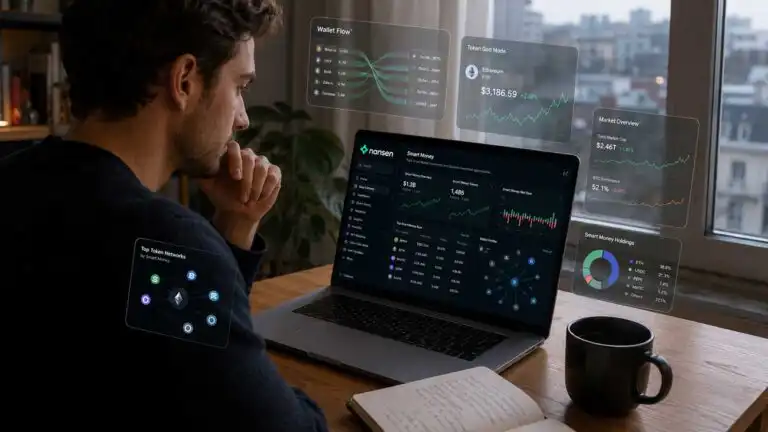
Nansen AI is an on-chain research, wallet intelligence and trading platform built around labelled blockchain addresses. Its main advantage is not that it can chat about crypto. General AI assistants already do that. Nansen can answer questions using wallet flows, token holdings, realised profit and loss, Smart Money cohorts and other data that a general model cannot reliably reconstruct from public web pages.
For this Nansen AI review, DIY AI evaluated the platform against our AI crypto research methodology, including research quality, explainability, on-chain intelligence, alerts, agent support, usability and cost. Nansen ranks first in our category with an overall score of 9.1/10. It is the best all-round option for investors who want to move from discovering a token to checking its holders, profiling relevant wallets and monitoring subsequent activity in one workflow.
The qualification is important: Nansen is an intelligence layer, not a prediction machine. A profitable wallet buying a token is evidence of activity, not evidence that the next trade will be profitable. The platform is most useful when its labels and AI summaries shorten an existing research process rather than replace one.
This review assesses Nansen as research software. It is not financial advice, and no analytics platform can remove the risk of loss in crypto markets.
Nansen AI review: the quick verdict
| DIY AI verdict | Best overall AI crypto research platform |
|---|---|
| Overall score | 9.1/10 |
| Best feature | Labelled wallet intelligence combined with Smart Money research |
| Best for | Active on-chain investors, token researchers, traders and AI-agent developers |
| Less suitable for | Passive investors, fundamental-only research and users looking for guaranteed trading signals |
| Free plan | Available, with restricted access compared with Pro |
| Pro price | $49 per month when billed annually or $69 month-to-month |
Our verdict: Nansen is worth testing because it compresses several separate jobs into one product: discovering unusual flows, identifying the wallets behind them, checking token distribution, creating alerts and continuing the investigation through an AI conversation. The value comes from Nansen’s labelled data and connected workflow, not from the language model alone.
Nansen
Scored across 9 practical DIY AI dataset metrics.
- AI Research Quality9.5/10★★★★★★★★★★
- Evidence & Explainability8.8/10★★★★★★★★★★
- On-chain Intelligence9.9/10★★★★★★★★★★
- Market & Narrative Intelligence8.3/10★★★★★★★★★★
- Coverage & Data Depth9.3/10★★★★★★★★★★
- Alerts & Monitoring9.4/10★★★★★★★★★★
- API & Agent Support9.2/10★★★★★★★★★★
- Ease of Use8.9/10★★★★★★★★★★
- Cost Efficiency7.4/10★★★★★★★★★★
What is Nansen AI?
Nansen began as an on-chain analytics platform that made anonymous blockchain activity easier to interpret through wallet labels and entity clustering. The current product goes further. It combines those analytics with a conversational AI agent, portfolio monitoring, alerts, APIs and integrated trade execution.
Nansen says its system covers more than 500 million labelled addresses. Labels can identify exchanges, funds, market makers, token deployers, experienced traders and other behavioural groups. This changes the research question from “what happened to this address?” to “what did this fund, exchange or profitable trader appear to do?”
The platform currently lists analytics support across 25 chains and ecosystems, including Ethereum, Solana, Base, BNB Chain, Arbitrum, Avalanche, Polygon, Optimism, Sui, Tron, TON and Hyperliquid. Coverage is not identical on every chain. A supported network may have price and wallet data without every label, leaderboard or token-analysis feature available elsewhere.
Nansen AI pros and cons
| Pros | Cons |
|---|---|
|
|
How DIY AI rated Nansen
Our scoring separates genuine research utility from AI branding. We reward tools that expose evidence, preserve access to underlying data and support repeatable workflows. Full category definitions are available in the DIY AI data methodology, while Nansen’s row and category comparisons appear in the AI crypto research tools dataset.
| Metric | Nansen score | Why it scored this way |
|---|---|---|
| AI Research Quality | 9.5/10 | The agent can work with wallet flows, token metrics and portfolio context rather than relying on general web knowledge. |
| Evidence and Explainability | 8.8/10 | Users can drill into wallets and transactions, although labels and generated interpretations are not infallible. |
| On-chain Intelligence | 9.9/10 | Smart Money cohorts, Profiler, holder analysis, PnL and entity labels are category-leading. |
| Market and Narrative Intelligence | 8.3/10 | Strong for behaviour visible on-chain, but weaker than dedicated narrative platforms for social and qualitative research. |
| Coverage and Data Depth | 9.3/10 | Broad multichain coverage and extensive labels, with some variation in feature depth by network. |
| Alerts and Monitoring | 9.4/10 | AI-created Smart Alerts turn a manual dashboard into an ongoing monitoring system. |
| API and Agent Support | 9.2/10 | API, CLI, MCP tooling, and x402 payments support both conventional applications and autonomous agents. |
| Ease of Use | 8.9/10 | The AI interface lowers the learning curve, but interpreting wallet behaviour still requires market knowledge. |
| Cost Efficiency | 7.4/10 | Pro is now much more accessible, though casual investors may not use the data frequently enough to justify it. |
| Overall | 9.1/10 | Best overall balance of AI research, labelled data, monitoring and execution. |
What Nansen AI does well
Nansen Agent turns natural-language questions into on-chain research
Nansen Agent is the conversational layer across the platform. A user can ask for the leading Solana tokens by Smart Money activity, investigate flows into a specific asset, check a portfolio or move from research towards a trade. Chat history synchronises between the web and mobile apps, which makes it practical to begin a deeper investigation on a desktop and continue monitoring it elsewhere.
The hidden advantage is schema access. A normal chatbot may recognise a token name and summarise recent commentary. Nansen’s agent can query structured wallet, token, PnL and flow data. This reduces the amount of manual filtering needed before a useful question can be answered.
There is still a verification step. Ask the agent to identify the wallets, timeframe and metric behind its conclusion, then open the supporting views. A polished answer without a defined cohort can hide whether the agent analysed funds, high-frequency traders, whales or a broad Smart Money label.
Smart Money is useful because it is segmented, not because it is always right
Smart Money tracks selected funds, institutional participants and historically profitable traders. Users can inspect net flows, holdings, decentralised-exchange trades, inflows, PnL leaderboards and perpetual positions. This is more useful than a generic whale feed because a large wallet and a consistently profitable wallet are different signals.
The common mistake is copying an address after a visible purchase. That ignores entry price, portfolio size, hedges, transfers between related wallets and trades happening elsewhere. A wallet can also be profitable because of one exceptional position rather than repeatable skill. Nansen helps expose this context, but it does not remove the need to interpret it.
Token God Mode makes token research inspectable
Token God Mode provides a concentrated view of a token’s holders, distribution, exchange balances, transactions, buyers, sellers and Smart Money involvement. Candle Inspector can connect a price movement to wallets that traded around the same period. This is particularly useful for checking whether a move was supported by several independent participants or dominated by a small cluster.
Holder concentration needs careful reading. Exchange, bridge, liquidity-pool, vesting and treasury addresses should not be treated like ordinary holders. Nansen’s labels help separate them, but unresolved or incorrectly clustered addresses can still distort the picture. The best workflow is to inspect the largest unexplained wallets rather than rely on one distribution score.
Profiler distinguishes repeatable behaviour from one lucky trade
Nansen Profiler is where wallet-level due diligence becomes more useful. It can show holdings, transaction history, counterparties, realised and unrealised PnL, token-specific entry and exit behaviour, and links between wallets. Wallet Pair Profiler adds relationship analysis through direct transactions and shared counterparties.
For copy-trading research, the most useful question is not “how much did this wallet make?” It is “how did it make the money?” Look for performance across several assets, holding duration, position rotation, losses, realised versus unrealised gains and whether the address received tokens before public trading. This filters out wallets whose leaderboard position cannot be replicated.
AI Smart Alerts are stronger than repeatedly checking dashboards
Smart Alerts monitor addresses, entities, token flows, exchange flows and contract interactions. Nansen’s AI can build an alert from a plain-language request, while manual controls remain available for users who want to set networks, minimum values and exclusions themselves. Notifications can be sent through channels including Telegram, Slack and Discord.
Alert quality depends on threshold design. Low thresholds applied to broad wallet groups create noise. Very high thresholds only report activity after it becomes obvious. A better setup starts with one token, one defined wallet cohort and a value range that fits the token’s liquidity. Review false positives before expanding it.
Portfolio monitoring adds risk context to isolated signals
Nansen Portfolio aggregates positions across chains and protocols, with real-time PnL, risk information and Smart Money attribution. This matters because a token that looks attractive in isolation may duplicate exposure already present through liquidity pools, lending positions or correlated assets.
The portfolio view is more valuable for active DeFi users than for someone holding a few assets on one exchange. Its role is visibility, not custody. Users should still distinguish between connecting a public address for monitoring and depositing assets into Nansen’s separate non-custodial trading wallet.
API, CLI, MCP and x402 make Nansen unusually useful for AI agents
Nansen exposes wallet analysis, token analytics and Smart Money data programmatically. Developers can use a conventional API key, a command-line interface and agent tooling compatible with workflows built around MCP. This lets a research agent request structured data instead of scraping charts or asking a general model to infer transactions from incomplete sources.
The x402 route is more unusual. An agent can pay per request using USDC rather than maintaining a normal subscription and API account. Nansen currently prices foundational endpoints at $0.01 per call and premium signal endpoints at $0.05 per call. A token-research workflow that combines several endpoints therefore has a visible marginal cost, which is useful for agents that run occasionally but can become expensive when polling continuously.
The limitations that matter before paying
A wallet label is a research hypothesis, not legal identity
Entity labels may be based on transaction patterns, known deposit addresses, public disclosures and clustering methods. They can become stale, or group addresses too broadly. A label such as fund, market maker, or Smart Money supplies useful context, but it should not be treated as proof of who controlled a transaction at a specific moment.
Smart Money can become a crowded and backwards-looking signal
Historical profitability is necessarily measured after trades occur. Once a wallet is widely tracked, followers may enter at worse prices and create short-lived demand around its visible activity. The useful edge often comes from understanding a pattern across several wallets, not receiving a notification that one known address bought.
On-chain visibility is not complete market visibility
Nansen cannot reveal private exchange positions, off-chain agreements, undisclosed hedges or the intent behind a transfer. A wallet sending tokens to an exchange may be preparing to sell, posting collateral, moving custody or doing something operational. The transaction is observable. The motive is inferred.
The AI interface can make weak assumptions feel decisive
Conversational output is easier to consume than a table, but it can compress ambiguity. Time windows, wallet cohorts, chain coverage and excluded address types affect the answer. Ask follow-up questions that force the agent to state those choices, especially before using words such as accumulation, conviction or exit.
Research and execution in one interface increases behavioural risk
Nansen can route spot trades and Hyperliquid perpetual trades from the research experience. This is convenient, but convenience can remove the pause in which a user would normally check liquidity, slippage, position size and invalidation conditions. Treat the agent’s trade action as a separate decision from its research answer.
A practical Nansen research workflow
The platform works best as a funnel. Begin broadly, then force each promising signal through narrower checks.
- Define the question. Specify the chain, token, timeframe and behaviour you want to investigate. “Find good tokens” is too vague. “Show Solana tokens with rising Smart Money balances over seven days but no sharp increase in holder concentration” is more useful.
- Use Nansen Agent for discovery. Ask for relevant assets, flows or wallets and require it to identify the metric and time window behind each result.
- Open Token God Mode. Check holder distribution, exchange flows, top buyers and sellers, Smart Money participation and transactions around major candles.
- Profile the important wallets. Inspect PnL across several tokens, holding duration, counterparties, entry timing and whether the wallet’s visible performance is repeatable.
- Cross-check outside the model. Review project fundamentals, governance, token unlocks, contract risk and social context. Nansen’s strongest evidence is behavioural and on-chain, not a complete investment thesis.
- Create a narrow alert. Monitor the specific wallets or flow conditions that would strengthen or invalidate the thesis. Do not alert on every transaction.
- Separate research from execution. Decide position size, liquidity limits, exit conditions and maximum loss before using integrated trading.
A recurring pattern among experienced users is that the value appears after they stop treating Smart Money as a buy list. The useful workflow is triangulation: identify a flow, inspect the wallets, check concentration and then monitor whether the behaviour continues. Following the first visible purchase usually means accepting somebody else’s timing.
See more of our reporting in Google Top Stories, AI Overviews and AI Mode.
Nansen pricing in 2026
Nansen now has two main plans: Free and Pro. This replaces the older Pioneer and Professional structure that made the full product difficult to justify for independent researchers.
| Plan or access route | Current price | What it is suited to |
|---|---|---|
| Free | $0 | Learning the interface, exploring available data and deciding whether Nansen’s labels improve your research. |
| Pro, annual billing | $49 per month, $588 per year | Regular research with full supported-chain access, 2,000 AI Agent prompts each month, full PnL and labels, unlimited portfolios and Smart Alerts. |
| Pro, monthly billing | $69 per month, $828 per year | The same core Pro access without a yearly commitment. |
| API credits | Usage based | Applications and research systems using Nansen endpoints through an API key. |
| x402 access | $0.01 or $0.05 per call | Agents and occasional workflows that need on-demand data without a normal subscription process. |
Pro also lists 10 basis-point trading fees, early feature access and one-time API or MCP credits. Trading costs should be evaluated separately from the subscription because routing, network fees, slippage and perpetual-trading costs can outweigh the platform fee.
The annual plan is the sensible option only after a user has a repeatable weekly workflow. Someone who checks one wallet after seeing a social post will struggle to recover $588 of annual value. A researcher monitoring several portfolios, running alerts and replacing hours of manual address investigation has a clearer case.
Is Nansen safe to use?
Researching a public wallet address does not require giving Nansen control of that wallet. Portfolio monitoring and transaction analysis can be separated from trade execution. Nansen also offers a non-custodial wallet powered by Privy for depositing, withdrawing and trading through the platform.
Non-custodial does not mean risk-free. Users still face smart-contract, token-approval, routing, bridge, market and account-security risks. Keep research wallets separate from trading wallets, never enter a seed phrase into an unexpected prompt, review token approvals, and begin with a small transaction before relying on a new execution route.
The data itself carries another form of risk: false confidence. A label or AI explanation can be wrong without any wallet being compromised. Important findings should be checked against the raw transaction, contract and relevant block explorer before they are published or used for a large position.
Who should use Nansen AI?
- Active on-chain investors: people researching wallets, flows, holders and DeFi positions across several chains.
- Token researchers: analysts who need to move from a token-level signal into wallet-level evidence.
- Swing and momentum traders: users who can combine Smart Money activity with liquidity, market structure and defined risk.
- Funds and research teams: groups that need shared monitoring, repeatable data access and faster entity investigation.
- AI-agent developers: builders who need structured on-chain data through APIs, CLI tools, MCP-compatible workflows or x402 payments.
Nansen is harder to justify for a passive investor who mainly holds Bitcoin or Ethereum on a centralised exchange. It is also a poor fit for anyone seeking a black-box signal service that tells them exactly what to buy. The product supplies better evidence. It does not supply certainty.
Nansen alternatives
| Alternative | Choose it instead when | Main trade-off |
|---|---|---|
| Arkham Intelligence | You want free-to-start entity attribution, wallet tracing and visual investigations. | Less complete as an all-round AI research and portfolio workflow. |
| Dune | You want auditable custom queries, dashboards and data for your own agents. | Requires more technical and data-analysis skill. |
| Messari Copilot | You prioritise cited reports, project fundamentals, governance and institutional research. | Less focused on wallet-level Smart Money investigation. |
| Kaito Pro | You need narratives, sentiment, catalysts and premium-source information search. | Weaker on-chain depth and substantially higher pricing. |
| Token Metrics | You prefer packaged AI grades, signals and portfolio guidance. | Model-generated scores are less inspectable than Nansen’s underlying wallet data. |
Nansen is the strongest compromise when one subscription needs to cover token discovery, wallet investigation, monitoring and agent-assisted execution. Dune is better for custom analysis. Messari is better for cited fundamental research. Kaito is better for narratives. Arkham is a strong starting point for investigators working with a smaller budget.
Frequently asked questions
Is Nansen AI free?
Nansen has a Free plan. Pro provides the fuller research experience, including 2,000 AI Agent prompts per month, supported-chain access, full PnL and labels, unlimited portfolios and unlimited Smart Alerts.
How much does Nansen Pro cost?
Nansen Pro costs $49 per month when billed annually, equivalent to $588 per year. Month-to-month billing costs $69, equivalent to $828 over 12 months at the reviewed price.
Can Nansen AI predict crypto prices?
Nansen can identify wallet flows, profitable cohorts, accumulation patterns and other signals that may inform a forecast. It cannot reliably predict future prices. Wallet behaviour can be misread, hedged elsewhere or already reflected in the market.
Can Nansen execute trades?
Yes. Nansen supports integrated spot-token trading and Hyperliquid perpetual trading, including execution through its AI Agent. Users should review the route, fees, slippage and position details rather than approving an AI-prepared transaction automatically.
Is Nansen better than Arkham?
Nansen is better for a connected workflow spanning Smart Money, token analysis, portfolios, alerts and AI-led research. Arkham is often the better free-to-start option for tracing entities and visualising wallet relationships. The right choice depends on whether the user needs a broad research workflow or focused investigation.
Does Nansen have an API for AI agents?
Yes. Nansen offers API access, CLI tooling, agent integrations and pay-per-call x402 endpoints. Developers can query Smart Money, wallet, token, PnL, transaction and related datasets without relying on the consumer dashboard.
Nansen AI verdict: the best overall option, with one condition
Nansen earns its 9.1/10 score because its AI sits on top of useful proprietary context. The agent can shorten research, but the labelled-wallet layer is what makes the product difficult to replace with ChatGPT and a collection of free dashboards. Smart Money, Token God Mode, Profiler and Smart Alerts form a coherent path from discovery to monitoring.
The condition is discipline. Nansen becomes less useful when it is treated as an automated tip sheet. Its strongest signals need cohort checks, wallet profiling, holder analysis and outside research. Used that way, it is the most complete AI-powered crypto research platform in our current dataset. Used as a copy-trading shortcut, it can simply help a user make an under-researched decision faster.
You Might Also Like:
Best AI Crypto Research Tools

AI Crypto Trading

AI Crypto Prediction